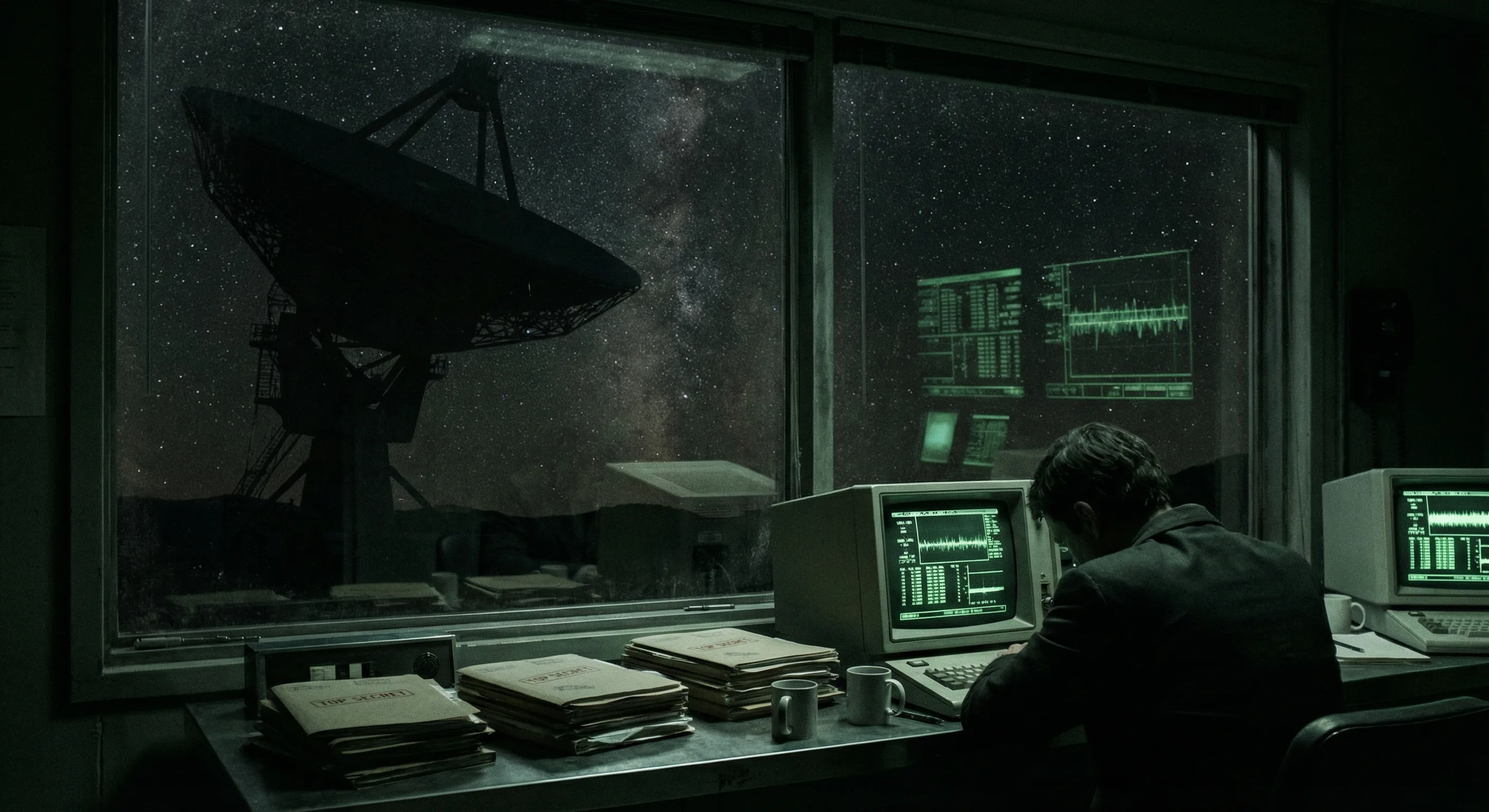
In the summer of 1950, physicist Enrico Fermi sat down to lunch at Los Alamos National Laboratory and asked a question that has haunted science ever since: "Where is everybody?" The universe is approximately 13.8 billion years old. Our galaxy alone contains an estimated 200 to 400 billion stars, a significant fraction of which host planets in the habitable zone. Life on Earth emerged within a few hundred million years of the planet cooling enough to support it. By the mathematics of probability, intelligent civilizations should be everywhere — visible, detectable, perhaps already here. And yet: silence.
This is the Fermi Paradox. It is not a question with a clean answer. It is a constraint that every proposed explanation must fit — and the implications of each proposed explanation are more unsettling than the question itself.
The Drake Equation, formulated by astronomer Frank Drake in 1961, attempts to quantify the number of communicating civilizations in the Milky Way. Even with conservative estimates for each variable, the result ranges from thousands to millions. The silence is statistically aberrant. It demands explanation.
// THE PARADOX IN FULL
The Fermi Paradox is not merely that we haven't detected alien signals. It is the contradiction between the high probability of extraterrestrial civilizations existing and the complete absence of evidence for any of them. The universe has had billions of years to produce spacefaring civilizations. Even at sub-light speeds, a civilization motivated to explore could colonize the entire Milky Way in 10 to 50 million years — a geological eyeblink in cosmic time. If even one civilization in the galaxy's history had expansionist tendencies, we should be swimming in their artifacts by now.
We are not. The sky is quiet. The SETI program has monitored billions of radio frequencies for decades. The result: nothing unambiguous. No repeating signal. No megastructure. No von Neumann probe parked in the asteroid belt. The absence is so profound that it has become a data point in its own right — and that data point is frightening to interpret.
// PROPOSED SOLUTION 01 — THE GREAT FILTER
The Great Filter, proposed by economist Robin Hanson in 1998, argues that somewhere between inert chemistry and a galaxy-spanning civilization, there exists a nearly insurmountable barrier. Something stops life — or intelligence, or technological civilization — from propagating. The question is whether that filter lies behind us or ahead of us.
If the Great Filter is behind us — if it is something in our evolutionary past, like the emergence of the eukaryotic cell, or sexual reproduction, or tool use, or language — then the silence of the universe is explained by our improbable uniqueness. We passed the filter. Almost nothing else did. This interpretation is cold comfort: it means we are alone, or nearly so, in a vast and empty cosmos.
If the Great Filter is ahead of us, the implications are catastrophic. It means that civilizations routinely reach our current technological level — and then do not survive it. Nuclear war. Climate collapse. Engineered pandemics. Misaligned artificial intelligence. Something kills every civilization before it can reach the stars. The silence is not emptiness. It is a graveyard.
The discovery of even microbial life on Mars would be, by this logic, the worst news in human history. It would suggest that the emergence of life is not the filter — pushing the filter forward, toward us, toward now.
// PROPOSED SOLUTION 02 — THE ZOO HYPOTHESIS
First proposed by radio astronomer John Ball in 1973, the Zoo Hypothesis suggests that advanced civilizations are aware of us — and have deliberately chosen not to make contact. We are being observed from a distance. Studied. Perhaps protected. The galaxy may be full of intelligence that has agreed, through some interstellar compact, to leave younger civilizations undisturbed until they reach a sufficient level of development.
This hypothesis is philosophically comfortable but empirically difficult to test. It requires that every civilization in the galaxy maintain the same policy of non-contact, with zero defectors, for billions of years. The behavior of a single rogue entity — one civilization that breaks the agreement — would reveal the conspiracy. That we have seen nothing suggests either the zoo is perfectly maintained, or it does not exist.
There is a darker variant: the Interdict Scenario. Perhaps we are not in a zoo. Perhaps we are in a quarantine. Perhaps the silence is not protective but punitive — or precautionary. Perhaps the galaxy has learned to stay away from civilizations at our particular stage of development.
// PROPOSED SOLUTION 03 — THE DARK FOREST
Science fiction author Liu Cixin formalized the most disturbing resolution in his 2008 novel The Dark Forest, but the underlying logic predates the fiction. The Dark Forest hypothesis argues that the silence is strategic. Every civilization in the universe understands that the existence of another civilization represents an existential threat. Resources are finite. Intentions are unverifiable. The rational move — the only safe move — is to destroy any civilization you detect before they can detect and destroy you first.
The universe is not empty. It is full of hunters who have learned to move without making noise. The civilizations that announced themselves are gone. The ones that survived learned silence. Earth, in broadcasting radio signals since the early 20th century, may have just ended our own eligibility for survival. We have been shouting into the dark forest for a hundred years. We do not yet know if anything has heard us.
This hypothesis cannot be dismissed. It is the logical extension of competitive resource dynamics applied at civilizational scale. It is also unfalsifiable in exactly the way a correct model of our situation would be: if it is true, we would not be contacted. We would simply be eliminated.
// THE HYPOTHESIS NOBODY WANTS TO SAY OUT LOUD
Every proposed solution to the Fermi Paradox assumes that contact has not happened. That assumption deserves scrutiny.
The UAP Disclosure Act, congressional testimony from intelligence officials, and the accelerating pace of declassification over the past decade suggest a different possibility: that the silence is managed. That the absence of publicly acknowledged contact is not evidence of no contact, but evidence of successful information control. That the paradox has a resolution that does not require filters, zoos, or dark forests — because the contact has already occurred, and the question now is not "where is everybody?" but "what has been decided on our behalf, and by whom?"
Former Deputy Assistant Secretary of Defense for Intelligence Christopher Mellon, speaking in 2020, described a pattern of government behavior around UAP data that he characterized as compartmentalized to the point of dysfunction — programs operating outside normal oversight, data that did not circulate through standard intelligence channels, decisions being made at levels that did not include elected representatives. This is not proof of contact. But it is exactly what managed contact would look like from the outside.
The Fermi Paradox is only a paradox if we accept the premise that we would know about contact. Remove that premise, and the paradox collapses. The silence is not the universe's silence. It is ours — carefully constructed, carefully maintained, and increasingly difficult to sustain.
// WHAT THIS MEANS FOR YOU
The Fermi Paradox is not an abstract philosophical puzzle. It is a decision framework. If the Great Filter is ahead, the work is survival: extending the window of civilization long enough to pass it. If the Zoo Hypothesis is correct, the work is development: becoming worthy of contact. If the Dark Forest is real, the work is silence and strategy. And if contact has already happened — if the silence is manufactured — then the work is readiness: knowing who you are when the information finally breaks through.
Your archetype determines your role in every one of these scenarios. The Scholar catalogs and interprets. The Sentinel monitors and protects. The Diplomat negotiates the terms of engagement. The First Contact steps forward when no one else will. The paradox resolves differently depending on which type of person you are when the answer arrives.