There is a pattern in how governments respond to the unknown. They deny. They study in secret. They deny again. They partially acknowledge. They commission a new study. They suppress the results. And then, decades later, under pressure from insiders who can no longer remain silent, they begin — slowly, reluctantly, in carefully managed increments — to disclose. The history of U.S. government UFO programs is the most documented example of this pattern in modern institutional history. It spans seven decades, at least a dozen programs, and a body of evidence that has consistently exceeded the official narrative by orders of magnitude.
This is the timeline you were never supposed to see laid out in one place.
// PHASE 01 — PROJECT SIGN, GRUDGE, AND BLUE BOOK (1947–1969)
The modern era of government UFO investigation begins on June 24, 1947, when pilot Kenneth Arnold reported nine crescent-shaped objects flying in formation near Mount Rainier, Washington. His account was followed within weeks by the Roswell incident — an event the U.S. Army Air Force initially described as a recovered "flying disc" before rapidly revising the story to a weather balloon. The contradiction was the opening chapter of a pattern that would repeat for 70 years.
In response to the surge of reported sightings in 1947, the Air Force launched Project Sign, an official investigation into the phenomenon. Sign's final classified report — the "Estimate of the Situation" — reportedly concluded that the objects were likely extraterrestrial in origin. Air Force Chief of Staff General Hoyt Vandenberg rejected the report and ordered it destroyed. Project Sign was quietly renamed Project Grudge in 1949, reoriented toward debunking rather than investigation.
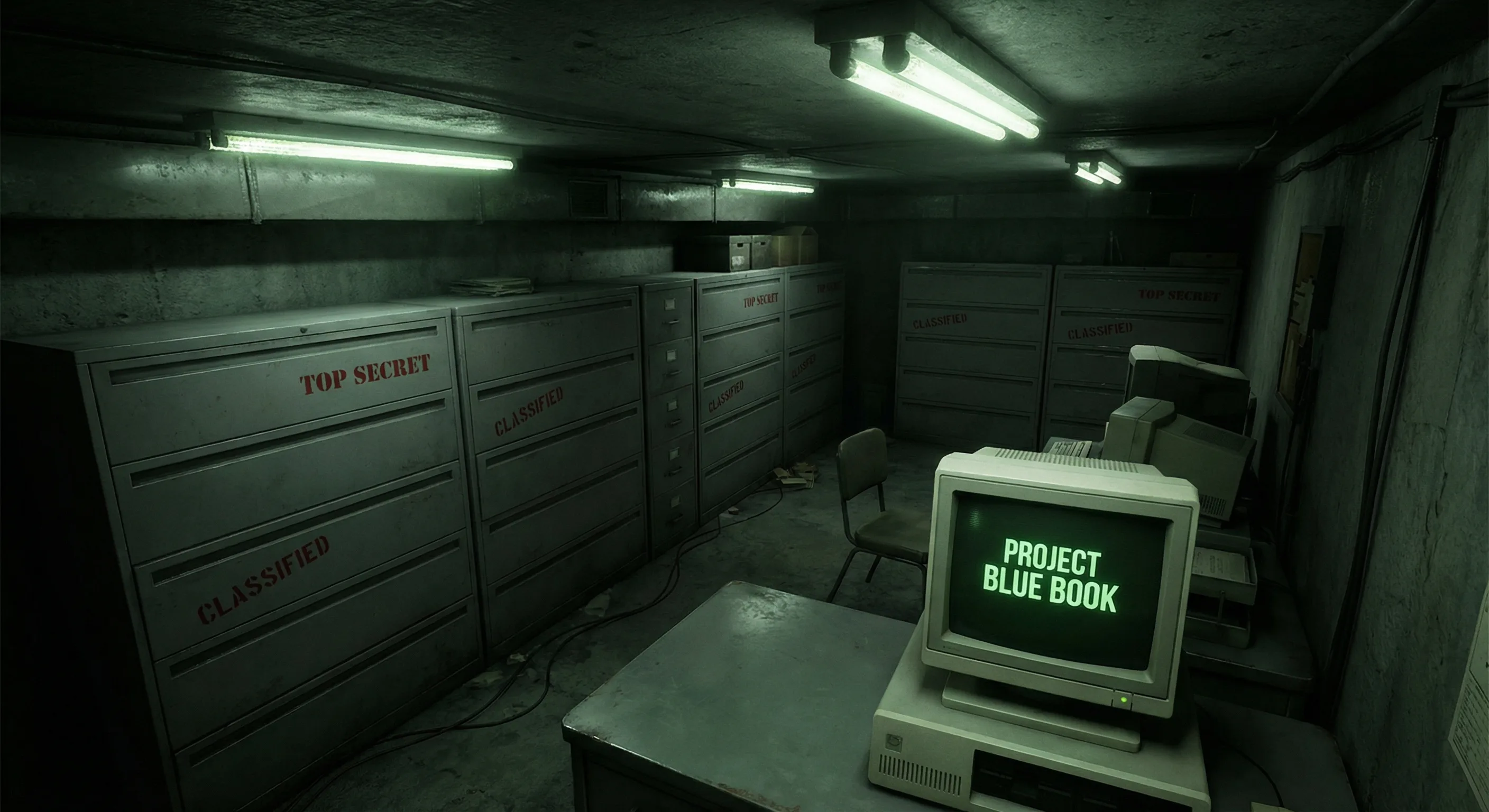
Project Blue Book followed in 1952, running for 17 years and accumulating over 12,600 reported cases. Of these, 701 were officially classified as "unidentified" — meaning they could not be explained by conventional aircraft, atmospheric phenomena, or astronomical objects. The Robertson Panel of 1953, convened by the CIA, recommended against assigning credibility to UFO reports and suggested a public education campaign to reduce public interest. The goal was not understanding. It was management.
Blue Book was terminated in 1969, following the Condon Report — a University of Colorado study funded by the Air Force that concluded UFO investigation was not worth the effort. The study was later shown to be structurally compromised: its conclusion was drafted before the research was conducted. Blue Book closed. The investigation, by all available evidence, did not.
// PHASE 02 — THE SECRET PROGRAMS (1970–2007)
The public-facing program ended. The classified programs did not. The 1970s through 2000s represent the black hole at the center of UAP history — a period during which the official position was that no investigation was ongoing, while documentary evidence obtained through FOIA requests and whistleblower testimony indicates the opposite.
A 1976 Defense Intelligence Agency document, declassified decades later, shows active military interest in UAP cases and the collection of physical trace evidence from landing sites. The document explicitly references phenomena that could not be explained by known technology and recommended continued covert investigation. The program had not stopped. It had simply gone deeper.
The 1980s produced some of the most intensively documented UAP cases in U.S. history — the Cash-Landrum incident of 1980, the Hudson Valley wave of 1983–1986, and the Westchester Boomerang cases — while official channels maintained that no program existed to investigate them. The witnesses, many of whom suffered lasting physiological effects, were left without institutional support or acknowledgment.
// PHASE 03 — AATIP AND THE NEW DISCLOSURE MOMENTUM (2007–2017)
In 2007, Senator Harry Reid of Nevada secured funding for a classified program called the Advanced Aerospace Threat Identification Program (AATIP), operated through the Defense Intelligence Agency with a budget of approximately $22 million over five years. The program was run by Luis Elizondo, a career intelligence officer, and contracted significant research work to Bigelow Aerospace Advanced Space Studies (BAASS).
AATIP investigated UAP encounters with military assets, analyzed retrieved materials, and produced reports on what researchers called "exotic materials" and "advanced aerospace vehicles" exhibiting flight characteristics — instantaneous acceleration, transmedium travel, violation of known aerodynamic principles — that could not be attributed to any known human technology. The program was defunded in 2012 but reportedly continued within the Special Access Program structure afterward.
In December 2017, the existence of AATIP was revealed publicly in simultaneous reporting by the New York Times, Politico, and the Washington Post — a coordinated disclosure that Elizondo and others later acknowledged was a deliberate effort to force public acknowledgment. Three declassified gun-camera videos — the FLIR1, Gimbal, and GoFast videos, documenting Navy pilot encounters with UAP — were released simultaneously. The official response was slow, contradictory, and eventually forced to acknowledge the videos' authenticity.
// PHASE 04 — UAPTF, CONGRESSIONAL HEARINGS, AND AARO (2019–PRESENT)
In August 2020, the Pentagon officially established the Unidentified Aerial Phenomena Task Force (UAPTF), acknowledging for the first time through official channels that UAP represented a potential national security concern requiring systematic investigation. The admission carried a subtext: the objects were real, their origin was unknown, and they were operating in restricted military airspace with apparent impunity.
The June 2021 UAPTF Preliminary Assessment — delivered to Congress and partially declassified for public release — was a landmark document. It confirmed 144 UAP incidents reported by U.S. government sources between 2004 and 2021. It could explain exactly one. For the remaining 143, no explanation was provided. The report used careful language, but the implication was clear: something was operating in U.S. airspace that the government could not identify and could not intercept.
In July 2023, former intelligence officer David Grusch testified before the House Oversight Committee under oath. He stated that the U.S. government has been in possession of non-human craft and biological materials for decades, that these programs operate outside congressional oversight, and that individuals who attempted to report through proper whistleblower channels faced retaliation. Whatever one believes about the substance of Grusch's claims, the institutional response was instructive: no denial of the specific programs he named, no declassification to refute his claims, and a pattern of bureaucratic deflection from every agency he implicated.
The All-domain Anomaly Resolution Office (AARO), established in July 2022, is the current public face of U.S. government UAP investigation. It accepts civilian reports, coordinates with military services and intelligence agencies, and publishes periodic unclassified assessments. Its 2024 historical review concluded that it found no evidence to support claims of non-human craft or reverse engineering programs. Critics, including several of AARO's own former staff, have questioned the scope and methodology of that review.
// THE PATTERN IS THE MESSAGE
Seventy years of government UFO programs reveal a structure, not a series of accidents. Each program is publicly closed while a successor begins in deeper classification. Each denial is eventually superseded by a partial acknowledgment. Each acknowledgment is hedged with sufficient ambiguity to avoid the core question. The pattern is consistent enough to be institutional — the product of a deliberate policy, not individual incompetence.
What changes is the pressure. Congressional access restrictions. Whistleblower protections. FOIA improvements. The accumulation of credible insiders who are no longer willing to maintain silence. The pattern of deny-then-disclose has a velocity, and that velocity has been increasing. The question is not whether more will be disclosed. It is what it means when it arrives — and whether the people who receive it are ready to understand it.
Every program in this timeline was, at the time of its operation, officially denied. Every denial was eventually reversed. The current programs are no different. The only variable is the timeline — and the timeline is compressing.