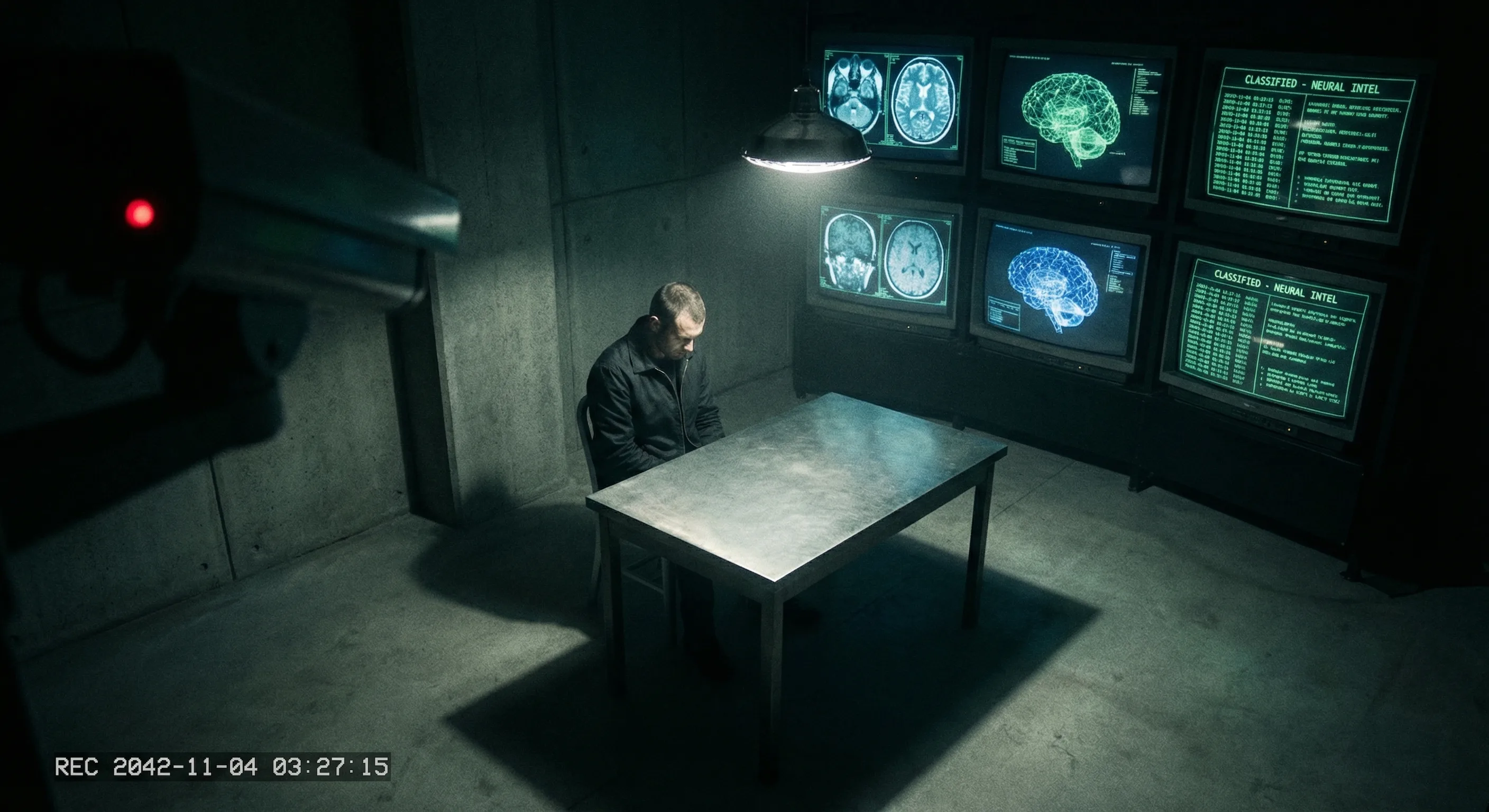
The most consistently reported aspect of UAP encounters is not the craft, not the light, not the movement. It is the witness's own reaction — a response that almost universally surprises them. People who believed they would remain calm freeze instead. People who considered themselves skeptics find themselves overwhelmed by certainty. People who feared they would panic become oddly focused. The psychology of the UAP encounter reveals something about human cognition that has been systematically ignored: anomalous stimuli break the normal rules of perception, memory, and behavior.
This briefing draws on decades of witness testimony, cognitive psychology research on extreme stress response, and the emerging field of close encounter psychology to explain not just what people do — but why, and what it tells us about who they are.
// THE NEUROLOGICAL REALITY OF ANOMALOUS ENCOUNTER
The human threat-detection system — centered in the amygdala but involving the entire limbic circuit — was optimized over millions of years for a specific class of threats: predators, hostile humans, physical hazards. It is exquisitely calibrated for pattern recognition within familiar threat categories. It is not calibrated for encounters that fall outside all existing categories.
When a witness observes a genuine UAP — an object that does not behave according to any known framework — the brain faces a categorization failure. The object is clearly a sensory input. It is clearly real. But no stored pattern matches it. The amygdala, unable to classify the threat correctly, does not simply fail to activate. It over-activates. The result is a neurological state that has been described by researchers as ontological shock: a sudden, profound disruption to the witness's fundamental model of reality.
Psychologist Dr. Diana Pasulka, in her research on UAP witnesses, documents a consistent post-encounter syndrome: disrupted sleep, altered worldview, changes in religious belief, increased philosophical orientation. The encounter does not merely disturb — it reorganizes. The witnesses who recover fastest are those who already had a framework, however incomplete, for interpreting the experience.
// FIGHT, FLIGHT, FREEZE — AND THE FOURTH RESPONSE
Most people are familiar with the fight-or-flight response. Fewer know that freeze — complete motor inhibition — is the more common response to genuinely novel extreme stimuli. It is not cowardice. It is the nervous system's default when fight and flight both fail the threat assessment: if you cannot categorize the danger, you cannot assess whether running would make it worse.
UAP witness accounts document the freeze response with striking consistency. The inability to move, speak, or operate technology during the encounter. The sense that time has stopped or dilated. The complete disconnection between intention — "I should be filming this" — and physical capability. Witnesses report knowing exactly what they should be doing and being unable to do it.
There is a fourth response, less discussed in standard stress literature but well-documented in high-performance contexts: engage. The engage response — moving toward the anomalous stimulus rather than away from or against it — correlates strongly with prior stress inoculation, a particular cognitive style marked by curiosity over threat-sensitivity, and what researchers in high-stakes decision making call situation awareness. Individuals who can engage under ontological shock are rare. They are also, in any first contact scenario, disproportionately important.
// HOW MEMORY DISTORTS UNDER ENCOUNTER CONDITIONS
Eyewitness testimony is notoriously unreliable even under ordinary conditions. Under the specific conditions of a UAP encounter — high emotional arousal, novel stimulus, absence of contextual framework, potential electromagnetic interference — memory distortion becomes severe and systematic.
The mechanisms are well-understood. High cortisol levels during acute stress enhance memory encoding for the central, emotionally salient features of an event while simultaneously degrading peripheral detail encoding. A witness will vividly remember the shape of the object and the feeling of the encounter, while being unable to recall how long it lasted, what direction it moved, or what they were doing before they saw it.
The post-encoding phase is equally problematic. Sleep consolidates memory. The disrupted sleep patterns documented in UAP witnesses mean that the memory undergoes repeated consolidation under abnormal conditions. Each consolidation cycle allows schema-consistent confabulation — the brain filling gaps with culturally available templates. A witness who consumed science fiction before the encounter may not be recalling the event; they may be recalling a culturally mediated reconstruction of it.
This is not evidence that encounters are not real. It is evidence that the reports of even sincere, credible witnesses require careful interpretation — and that the investigative protocols for post-encounter interviews must be significantly more sophisticated than they currently are.
// WHY YOUR ARCHETYPE IS PREDICTIVE
The DISCLOSURE framework's five archetypes — Sentinel, Diplomat, Scholar, Survivor, First Contact — are not personality categories in the conventional sense. They are stress-response profiles: descriptions of how different cognitive and psychological structures respond under conditions of extreme uncertainty and novel threat.
The Sentinel Under Encounter
Activates protective protocols immediately. Their attention narrows to their immediate environment and the people in it. They are less likely to freeze than other archetypes because their threat response is action-oriented and familiar with unknown-threat scenarios. The Sentinel's weakness in an encounter is the same as their strength: their protective instinct may cause them to position the contact as a threat before sufficient data exists to make that determination.
The Diplomat Under Encounter
Resists the threat-frame from the start. Their cognitive orientation toward communication means that their initial response is interpretive rather than defensive — "what is it trying to convey?" rather than "how do I respond to the danger?" This orientation produces slower freeze responses and faster recovery from ontological shock. The Diplomat's risk is over-attribution of intent where no intent is yet decipherable.
The Scholar Under Encounter
Activates documentation mode. Their training and cognitive orientation compel data collection, which provides a functional behavioral response that bypasses the freeze mechanism. The Scholar is the most likely archetype to successfully record an encounter, and the most likely to produce credible post-encounter testimony. Their weakness is emotional dissociation: the documentation behavior can become a defense mechanism that delays processing.
The Survivor Under Encounter
Activates extraction mode. The Survivor's response to ontological shock is behaviorally the most consistent of all archetypes — they move. Where Sentinels assess, Diplomats interpret, and Scholars document, Survivors initiate withdrawal and protective action immediately. This makes the Survivor the least likely archetype to freeze and the most likely to successfully remove dependents from a contact scenario. Their risk is premature departure — exiting before threat vectors are confirmed, potentially spreading alarm through their movement, or abandoning people who needed more time to respond.
The First Contact Under Encounter
The most paradoxical profile. Research on crisis response identifies a small population of individuals who, under conditions that paralyze most people, experience something that witnesses describe as clarity. Not absence of fear — presence of purpose. The First Contact archetype under ontological shock does not freeze, does not flee, does not document. They orient. They engage. Their response is the one that changes outcomes, for better or worse, and it cannot be explained by training or preparation alone. It is constitutive.
// THE QUIZ AS PSYCHOLOGICAL INSTRUMENT
Understanding your archetype before an encounter — whether that encounter is a personal UAP sighting or the civilizational-scale event of confirmed disclosure — provides a form of stress inoculation that training alone cannot replicate. Knowing how you are likely to respond allows you to prepare for your own failure modes. The Sentinel prepares to consider non-threatening interpretations. The Diplomat prepares to acknowledge genuine danger. The Scholar prepares to process the emotional dimension of the experience. The Survivor prepares to coordinate withdrawal without triggering panic. The First Contact prepares to act with appropriate caution.
The DISCLOSURE protocol is built on a single insight: the prepared witness changes outcomes. The psychology of UAP encounters is not a field of abstract research. It is an operational map for the most significant events of the coming years — and the people who have read the map before the territory appears will be the ones who make it count.
You will not choose how you react. Your nervous system will choose for you — unless you have done the work in advance. Archetype knowledge is not preparation for performance. It is preparation for recognition: knowing, in the moment, what is happening inside you, and what to do with it.