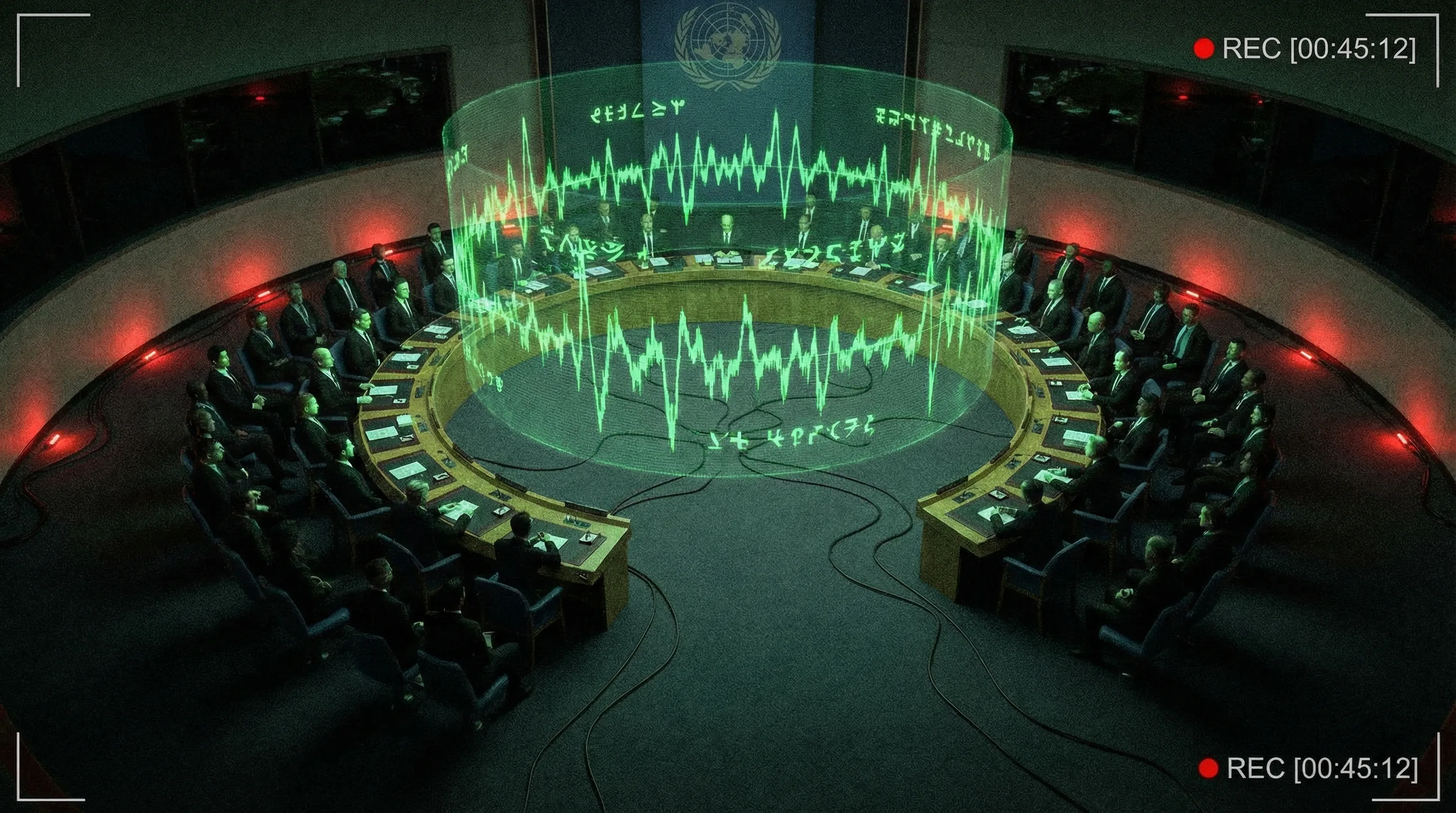
Every culture has an answer to this question, embedded in its myths, its religion, its science fiction. The spacecraft hovering over Washington. The radio signal decoded after years of work. The figure emerging from the hatch, hand extended. The reality, informed by actual scientific protocols, military command structures, and the documented psychology of crisis response, is considerably more chaotic, slower, and stranger than any of those scenarios suggest.
This briefing is a scenario analysis. It is not speculation. It is an evidence-based reconstruction of what would likely happen during and after confirmed non-human contact, drawn from SETI post-detection protocols, government emergency response frameworks, academic studies of information disclosure under crisis conditions, and the documented behavior of institutions facing paradigm-breaking events.
The picture is not reassuring. The picture is, however, actionable — and that is what matters.
// PHASE 01 — DETECTION: THE FIRST 72 HOURS
Most people imagine first contact as a public event — a ship appearing over a major city, an unmistakable signal broadcast on every frequency simultaneously. The more probable scenario is the opposite: detection happens inside a classified program, through military or intelligence infrastructure, and the information is immediately compartmentalized before any public knowledge can form.
SETI (Search for Extraterrestrial Intelligence) operates under a formal post-detection protocol, developed by the International Academy of Astronautics. It requires the detecting institution to verify the signal through independent observation before any announcement, to notify relevant national authorities, and to coordinate international notification through the United Nations. The protocol is voluntary and legally non-binding. It assumes that detection happens through civilian scientific channels.
If detection happens through military channels — which UAP researchers argue is the more likely vector, given the concentration of sensing infrastructure in defense systems — the protocol does not apply. The information enters the classification system, and decisions about disclosure are made by people whose primary mandate is security, not transparency.
In every major government disclosure of sensitive information — from nuclear incidents to pandemic origins to covert program exposure — the critical decisions are made in the first 72 hours. Who is told. What is contained. How the narrative is framed. The public does not enter the picture until that window has already closed.
// PHASE 02 — GOVERNMENT RESPONSE: THE CHAIN OF CONTROL
Assume confirmed contact — an unambiguous signal, an object of verified non-human origin, or a face-to-face encounter documented by multiple defense assets. The response chain is roughly as follows:
- Military command notification. Depending on the nature of the contact, this begins with the relevant combatant command (NORAD, USSPACECOM, or a theater-level command) and escalates rapidly to the Chairman of the Joint Chiefs and the Secretary of Defense.
- Presidential briefing. The President is notified through the National Security Council. Whether this is the first presidential exposure to UAP information is itself a contested question — multiple presidents have reported difficulty obtaining UAP briefings from the intelligence community.
- Intelligence community lockdown. The relevant programs — almost certainly Special Access Programs not subject to standard congressional oversight — would implement information control protocols. The circle of awareness would be deliberately constrained.
- International notification — selectively. Close allies would likely be notified under intelligence-sharing agreements. The UN would be notified only if and when public disclosure became unavoidable.
- Public information strategy. This is the phase that matters most for civilians. The decision about what to tell the public, how much, and in what framing, would be made by communications professionals and national security lawyers, not scientists. The objective would be to prevent panic, maintain social order, and preserve the authority of existing institutions.
The model for how this would unfold is not science fiction. It is the documented behavior of governments during the COVID-19 pandemic, the 2008 financial crisis, and every major nuclear incident since 1945. Institutions protect themselves first. Information is released in calibrated doses. The public is managed.
// PHASE 03 — CIVILIAN RESPONSE: THE CASCADE
Decades of research on mass response to unexpected catastrophic news reveals a consistent pattern: immediate shock, followed by a rapid sorting of the population into behavioral categories that do not correspond to the categories people believe they occupy before the event.
The people who said they would remain calm often do not. The people who said they would panic sometimes become the most functional individuals in the room. The determining factors are not personality, not education, not prior belief in extraterrestrial life. They are psychological profile, prior exposure to stress inoculation, and the presence or absence of a pre-existing framework for interpreting the event.
Religious institutions would face an immediate and potentially existential challenge. The major Abrahamic faiths have all, to varying degrees, developed theological frameworks for the possibility of non-human intelligence — but doctrine and lived psychological reality are different things. Economic markets would respond before full information was available, driven by uncertainty rather than data. Supply chains, communication infrastructure, and civil governance would face stress from changed civilian behavior before any direct threat materialized.
The chaos would not be caused by the contact itself. It would be caused by the gap between what is known and what is communicated.
// PHASE 04 — WHERE THE ARCHETYPES EMERGE
In every major crisis event — and first contact would be the largest crisis event in human history — a population that appears homogeneous under normal conditions rapidly differentiates into distinct behavioral groups. The DISCLOSURE framework identifies five archetypes that correspond to documented crisis response profiles:
The Sentinel
Moves into protective mode immediately. Prioritizes the safety of their immediate community — family, neighbors, local infrastructure. Focuses on practical continuity: food, communication, shelter, security. The Sentinel does not need to understand the contact; they need to keep people alive through the disruption it causes. In a first contact scenario, Sentinels become the backbone of community stability while institutions reorganize.
The Diplomat
Orients toward communication and de-escalation. Seeks to understand the nature and intentions of the contact. Looks for frameworks — linguistic, mathematical, symbolic — that might bridge the gap between human and non-human cognition. The Diplomat's instinct is that contact is inherently manageable if approached correctly. In a first contact scenario, Diplomats become the architects of whatever communication protocol emerges.
The Scholar
Documents, analyzes, and contextualizes. The Scholar's response to unprecedented events is systematic data collection. They are the people reviewing footage, cataloging physical evidence, cross-referencing the contact against prior knowledge, building the intellectual infrastructure that everyone else will eventually rely on. In a first contact scenario, Scholars become the institutional memory of the event.
The Survivor
Extracts and protects. The Survivor's response to a contact event is not hesitation — it is immediate, purposeful movement away from the contact zone, with dependents accounted for. Survivors are the reason civilian populations remain intact during large-scale anomalous events. They read exits before they read rooms. In a first contact scenario, Survivors become the architects of civilian continuity — ensuring that the people who cannot contribute to the contact response are not caught in the middle of it.
The First Contact
The rarest type. The individual who, in the moment of contact, steps forward without waiting for permission or instruction. Not because they are fearless, but because their psychological orientation — curiosity, openness, absence of defensive reflex — positions them as humanity's natural representative. History produces a handful of these people in each generation. First contact would reveal who they are.
First contact will not look like the movies. It will look like every other major institutional crisis: chaotic, managed from the top, information-controlled, and deeply dependent on the behavior of individuals who understood their role before it happened. The prepared civilian is not a passive recipient of disclosure. They are an active variable in the outcome.