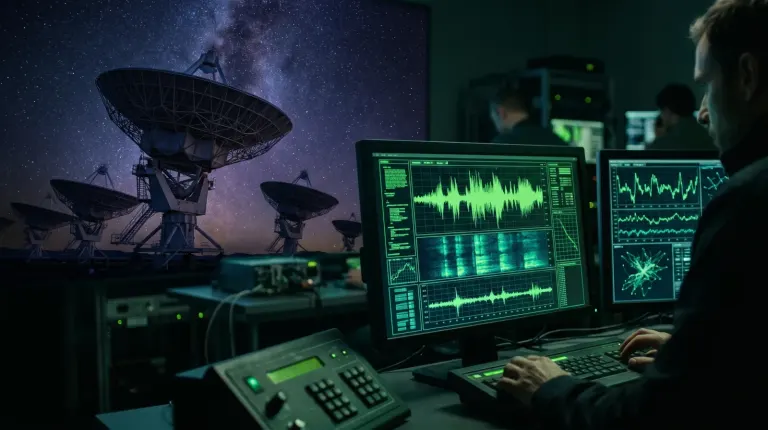

The Rio Scale is a scientific rating system for thinking about how important a possible extraterrestrial signal claim might be. It does not prove aliens are real. It helps separate a world-changing detection from a noisy headline.
That makes it useful for civilians. During disclosure pressure, the public will see clips, rumors, candidate signals, anonymous claims, official statements, and viral overreaction. A scale forces the first sane question: how credible is this, and how big would it be if true?
What is the Rio Scale?
The Rio Scale was developed in the SETI community to communicate the significance of a possible detection. It is commonly described as a 0 to 10 scale, where low scores mean little verified importance and high scores point toward a potentially civilization-level discovery.
The point is not numerology. The point is structured judgment. A rumor on a message board, a single unexplained radio burst, a repeatable narrowband signal, and a decoded message would not belong in the same category.
Why do people ask about this?
People turn to the Rio Scale when a signal story goes viral or when they want to know whether a claimed discovery would count as first contact. The hidden question is usually emotional: should I care, or is this another false alarm?
The scale answers with discipline. A claim can be interesting without being confirmed. It can be consequential if true while still weak today. That is the exact kind of thinking civilians need when public pressure outruns the evidence.
What does the scale measure?
Rio-style thinking looks at two broad dimensions: consequence and credibility. Consequence asks how important the event would be if the claim were true. Credibility asks how strong the evidence is, how reliable the source is, and whether independent checks support it.
- Low consequence, low credibility: noise, hoax, vague claim, or weak anomaly.
- High consequence, low credibility: dramatic story with poor support. Treat carefully.
- Low consequence, high credibility: useful technical result that may not change civilization.
- High consequence, high credibility: the category that demands public preparation.
Why a score can mislead
A number feels clean. Reality is not. A score can change as new evidence arrives. A candidate can fall after interference is found. A strange signal can rise if repeated by independent instruments. Early claims are unstable by nature.
That is why civilians should not tattoo the first number onto their worldview. Use the scale as a throttle. Slow the reaction. Ask what changed. Ask who verified it. Ask whether the source is showing data or selling certainty.
How civilians should use Rio thinking
- Identify the claim. Signal, object, message, biological evidence, or policy statement.
- Identify the source. Observatory, agency, paper, witness, journalist, or anonymous account.
- Identify the evidence. Raw data, replication, metadata, instruments, and chain of custody.
- Identify the consequence. Would this change science, security, religion, markets, or daily life?
- Identify your role. Are you protecting, calming, documenting, interpreting, or spiraling?
That final line is why the classification quiz exists. Science can rate the signal. You still need to rate yourself.
How does this connect to first contact readiness?
First contact may not arrive as a ship over a city. It may arrive as a score, a press conference, a data release, or a signal claim that takes days to verify. The first public event could be uncertainty.
Prepared civilians are useful in uncertainty. They keep people steady, document what is known, stop false certainty from spreading, and know when to wait. Use the First Contact briefing and readiness to build that reflex now.
- SETI post-detection protocol explains what happens after a credible signal candidate.
- The Fermi Paradox frames why silence and detection are both complicated.
- Are we alone in the universe? keeps the scientific question grounded.
- Intel briefings collects the public record and field guides.
- First Contact, Readiness, and Classification turn rating discipline into response discipline.
Common questions
Is a Rio Scale score proof of aliens?
No. A score is a way to communicate significance and evidence quality. It is not proof by itself.
Why does the Rio Scale matter for civilians?
It gives civilians a way to slow down and ask how credible, repeatable, and consequential a claim is before reacting to a headline.
See also The same idea, judging the evidence rather than the excitement, drives the report strength meter on our sighting report form.