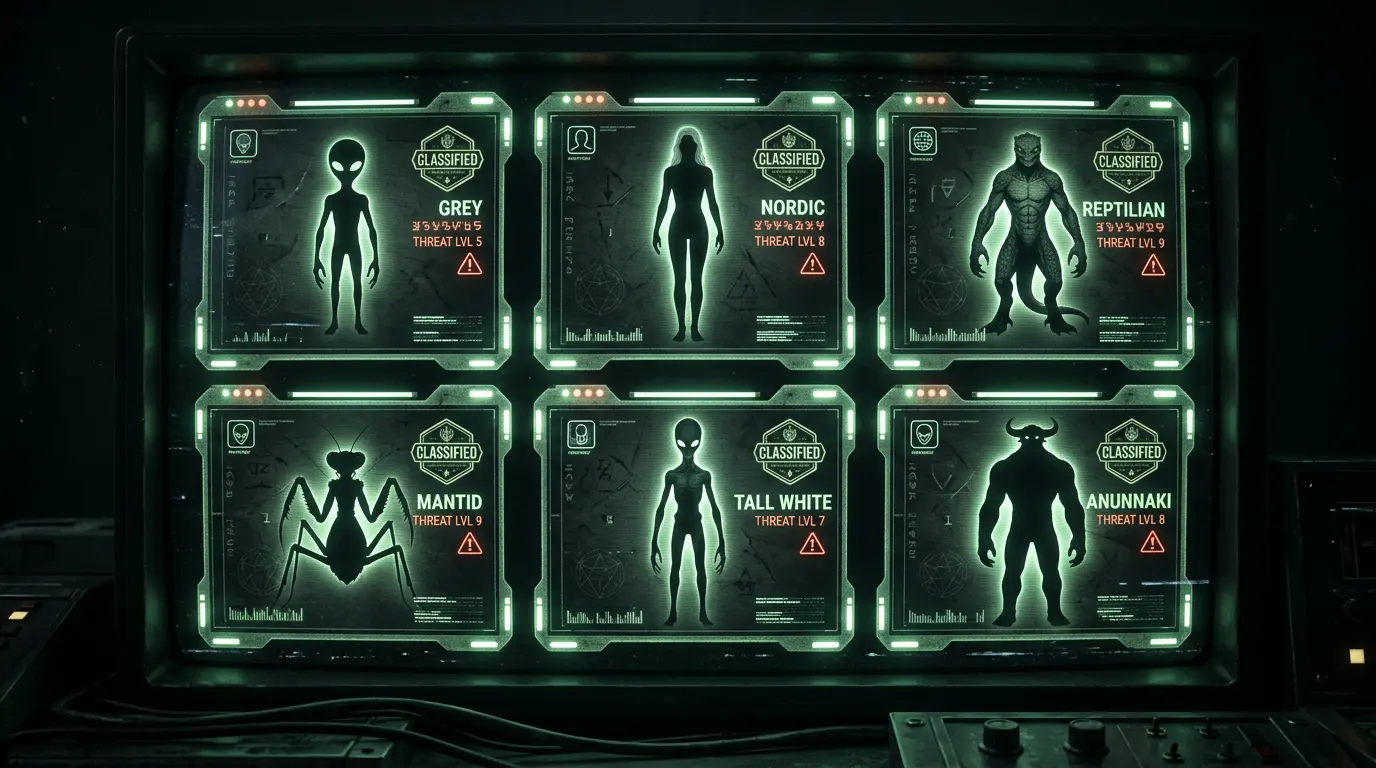
Six species. Six threat profiles. The government has known about all of them.
What follows is a partial declassification of the DISCLOSURE contact registry — the first organized attempt to provide civilians with species-specific threat assessments based on documented encounter evidence. This is not speculation. Every classification in this registry is derived from pattern analysis of contact testimony, government whistleblower accounts, and regression data that spans more than seven decades.
Understanding threat classification matters for one reason: the correct response to a contact event is entirely species-dependent. A response that de-escalates a Grey encounter will escalate a Reptilian one. A response that works with Tall Whites will fail completely with Mantids. Without species identification, you have no protocol. Without protocol, you have no preparation. That gap is what this registry exists to close.
Species are listed in descending threat order.
// SPECIES 01 — THE ANUNNAKI
The Anunnaki dossier carries a CLASSIFIED designation — meaning it supersedes the standard threat scale. This is not an administrative designation. It reflects the nature of the intelligence itself: the Anunnaki are the only species in the contact registry whose file pertains directly to human origins.
Cuneiform records from ancient Sumer, the Enuma Elish, and the Atrahasis Epic contain the oldest documented accounts of what contemporary researchers classify as Anunnaki contact. Zecharia Sitchin's translations of these texts — covering genetic modification, species creation, and long-cycle planetary visitation — remain controversial in mainstream scholarship but are taken seriously within contact research circles. The pattern of the evidence is consistent across too many independent sources to dismiss.
What this means for civilian preparation: you do not have a protocol for Anunnaki contact. Nobody does — publicly. The full dossier is locked at Clearance Level 5 in the Disclosure app. Only 6% of registered users have achieved that clearance. The others are still learning what they're dealing with. Start there.
// SPECIES 02 — THE REPTILIAN
CRITICAL is the highest threat classification on the standard scale. Reptilian entities earn this designation not through aggression for its own sake, but through the nature of their behavioral architecture: they operate on a hierarchy-dominance model in which every encounter is an assessment. They are apex predators, and they process all interaction through that lens.
Phil Schneider's 1995 accounts of Dulce Base — describing a 1979 underground confrontation that left him with two fingers severed — are among the most cited whistleblower testimonies referencing Reptilian contact. Military accounts and regression testimony across multiple independent researchers describe a consistent behavioral signature: size dominance, direct eye challenge, and immediate assessment of threat potential in any entity encountered.
The key survival consideration: the first 10 seconds of a Reptilian encounter determine the outcome. Everything after that is a continuation of what those 10 seconds established. If you don't know what to do in those 10 seconds, you are not prepared. The full protocol is classified inside the Disclosure app at Readiness Level 3.
// DISCLOSURE APP — SPECIES SURVIVAL PROTOCOLS //
Full species dossiers, survival protocols, and signal training are classified inside the Disclosure app. Your readiness score determines what gets unlocked.
TRAIN TO SURVIVE — GET THE APP →// SPECIES 03 — THE GREY
The Grey is the most frequently documented non-human intelligence in contact events. Betty and Barney Hill's 1961 abduction — the first extensively documented civilian contact case — established the behavioral template that has been corroborated by hundreds of subsequent regression accounts. Travis Walton's 1975 encounter, Whitley Strieber's documented contact history, and the entity designated EBE1 from Roswell all fit the same profile.
Grey entities are methodical and mission-focused. They do not appear to have emotional response systems in any human-recognizable sense. They are collectors: of biological samples, genetic material, behavioral data. Aggression is not their default — but it is a documented response to resistance. Memory manipulation is standard operating procedure for Grey contact. The majority of encounters are not remembered by the subject at all.
Key survival consideration: stillness and non-resistance are the only documented effective responses. The full Grey encounter protocol — including the specific cognitive techniques that prevent involuntary compliance — requires Readiness Level 2 in the Disclosure app.
// SPECIES 04 — THE MANTID
Mantid entities — insectoid in appearance, typically described as 6-8 feet tall with elongated limbs, triangular heads, and compound eyes — are classified HIGH for a specific reason: they are surgical-class operators. They are not aggressive in the way Reptilians are. They are scientists. You, in a Mantid encounter, are a subject of study. That distinction does not make the encounter safer. It makes it more disorienting.
Budd Hopkins' regression research, Karla Turner's documented case accounts, and consistent testimony from the 1987 regression pool describe a signature behavioral profile: clinical detachment, organized procedure, and complete absence of concern for the subject's emotional state. Mantid encounters often involve paralysis of the subject, followed by systematic observation and procedure with no explanation offered.
// SPECIES 05 — THE NORDIC
CONDITIONAL does not mean safe. It means the conditions matter. Nordic entities — humanoid, typically described as tall with light hair and blue or silver eyes — carry a CONDITIONAL designation because their behavior is explicitly context-dependent. They are observers by default. When they make direct contact, something about the conditions has changed. That change is what you need to understand.
George Adamski's 1952 documented contacts, Howard Menger's accounts, and Billy Meier's extensively documented Pleiadian contact cases describe a consistent behavioral signature: calm, observational, and explicitly non-interventionist until something triggers direct engagement. What triggers it varies. The full analysis of Nordic contact triggers is classified inside the Disclosure app.
// SPECIES 06 — THE TALL WHITE
Tall White entities are classified CONDITIONAL — Teacher Class. The Charles Hall documentation (1964-1967, Nellis AFB) is the most detailed long-term contact record in the civilian registry. Hall, a US Army weatherman stationed in the Nevada desert, spent three years in documented regular contact with Tall White entities and survived by learning their behavioral rules. That is the key data point: they have rules, and they can be learned.
The primary survival consideration with Tall Whites is the assessment model. Every encounter is an evaluation. They are deciding something about you. They respect demonstrated competence and cannot tolerate perceived weakness. The 90-second window — approximately the time they allow for you to demonstrate value — is the critical variable. Full Tall White encounter protocol is available at Readiness Level 1 in the Disclosure app.
Six species. The question is not whether contact will happen. It's whether you'll know what you're dealing with when it does. Every encounter in the registry that ended without permanent harm to the civilian involved had one thing in common: the person knew — or quickly learned — the behavioral rules of the entity in front of them. The ones who didn't know those rules paid for it.
This registry is the floor. The full dossiers are inside the app. Your readiness score determines which ones you can access. Start building it.
Related: The Complete Alien Survival Guide: 6 Species, 6 Protocols →