

Stay calm, start recording, keep your distance, collect reference points, and write your notes before memory starts editing the event. That is the short answer, whether you call it a UFO or a UAP.
Use UFO if that is the word you know. Use UAP if you want the current official term. In the field, the label matters less than the behavior. If something in the sky or nearby airspace does not match known aircraft, drones, satellites, weather, or astronomy, treat the moment like evidence that can disappear.
This guide is not asking you to believe anything. It is asking you to function. A prepared civilian does three things better than everyone else: stays calm, records clean data, and avoids making the situation worse.
What should you do first?
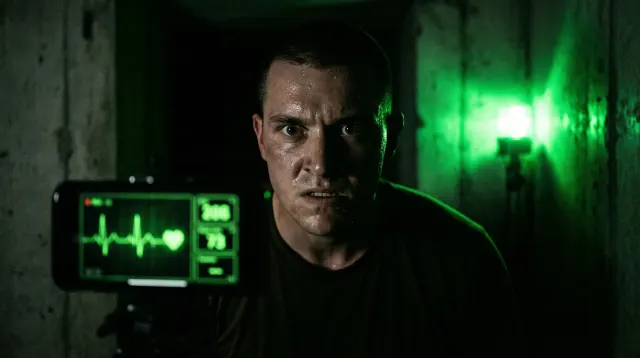
Your first job is not to identify the object. Your first job is to keep your nervous system useful. Strange light, impossible motion, silent hovering, sudden acceleration, or a shape you cannot place can trigger a freeze response. That is normal. It is also where evidence dies.
Take one slow breath before you touch your phone. Tell yourself: I am an observer. That sentence gives your brain a role. A role is easier to follow than raw fear.
- Do not run toward it. Distance protects you and keeps your footage stable.
- Do not post first. Public reaction can wait. The object will not.
- Do not argue with witnesses. Let each person describe what they saw before you compare notes.
If you want the broader civilian framework, read the First Contact briefing after the event. During the event, keep the protocol small.
How do you record a UFO or UAP sighting?
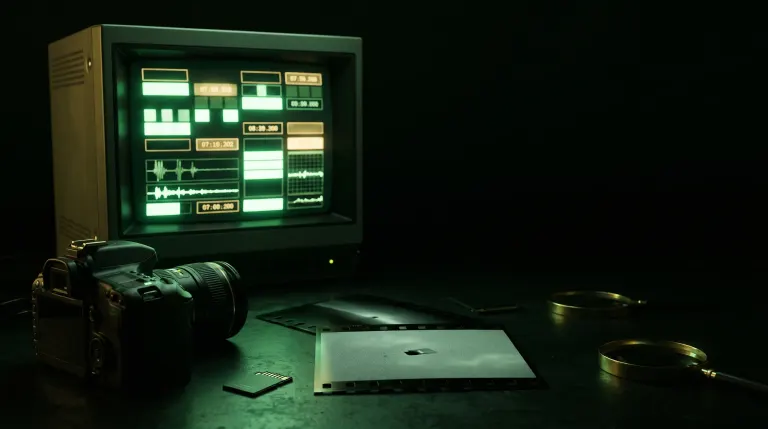
Record video immediately. Video captures motion, audio, context, and timing in a way still photos cannot. The best UFO footage is not the most cinematic footage. It is the footage that gives investigators something to measure.
- Start wide. Capture the object plus trees, rooftops, mountains, power lines, or the horizon.
- Hold steady. Brace your elbows against your body, a vehicle, a wall, or a railing.
- Say the basics out loud. Time, location, direction, weather, sound, and what the object is doing.
- Zoom only after context is captured. A tight glowing dot with no reference point is almost useless.
- Keep recording after it leaves. Capture the empty sky, animal reactions, electronics, traffic, and any witnesses.
If you are with another person, split roles. One person records wide. One records close. One watches without a screen and narrates. That division is how a random crowd becomes a field team.
What details matter most after a sighting?
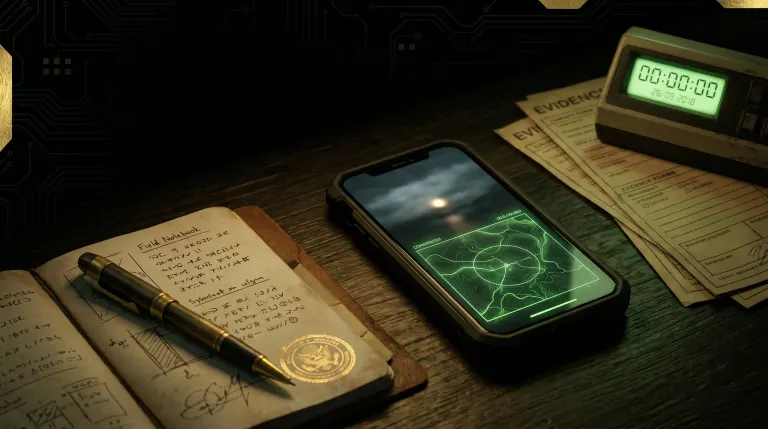
Write your notes before you watch the video, text anyone, or read comments. Memory changes quickly under stress. Your first written account is usually the cleanest one.
- Exact location, ideally with GPS coordinates from your phone.
- Start time, end time, and whether the event felt shorter or longer than the clock shows.
- Shape, color, light behavior, altitude estimate, direction of travel, and movement pattern.
- Sound, silence, vibration, smell, temperature shift, or electronic interference.
- Nearby aircraft, satellites, drones, fireworks, weather, or known launch events that could explain it.
- Names and contact details for independent witnesses.
Then make a clean evidence copy. Save the original video. Do not crop, filter, stabilize, or add music to the version you plan to report.
What should you not do?
Do not approach a landed object, unknown craft, unusual debris, strange light source, or possible contact zone. You do not need to assume danger to respect uncertainty. Distance is discipline.
Do not chase it in a vehicle. Do not point lasers at it. Do not fire anything. Do not trespass for a better angle. Do not let a crowd press forward because everyone wants proof. If the moment is real, a calm witness is more valuable than a reckless hero.
This is where archetype awareness matters. A Sentinel may over-defend. A Scholar may over-focus on data and ignore safety. A Diplomat may move too close. A Survivor may leave before documenting. Learn the pattern on the archetypes index before the pattern chooses for you.
How do you report a UFO sighting?
Report only after you have preserved your original evidence and written your first account. A useful report is specific, calm, and boring in the right places.
- Use a civilian reporting database. NUFORC and MUFON are common North American options for public UFO and UAP reports.
- Use local emergency channels only when there is immediate danger. Fire, injury, hazardous debris, aviation risk, or public safety concerns belong with local authorities.
- Share originals with investigators, not edited clips. Metadata, audio, and context matter.
- Keep one private incident log. Store video, notes, witness names, weather, and report links in one place.
For a broader preparation path, move next to how to prepare for alien contact and the readiness file.
What is your role if contact escalates?
A UFO sighting is usually an observation event. First contact would be a role event. The difference matters. In an observation event, you document. In a contact event, your default response affects people around you.
DISCLOSURE classifies civilian response into Sentinel, Diplomat, Scholar, Survivor, and First Contact profiles. The point is not to decorate your identity. The point is to know what you will likely do under pressure, what you will miss, and who you should stand near.
If you freeze, you need a script. If you protect, you need restraint. If you analyze, you need action. If you withdraw, you need timing. If you engage, you need humility. The classification quiz gives you that map before the sky gives you the test.
See also Once you are safe, note the time and direction and check what was actually in that part of the sky. If you are in Canada, here is where your report goes.