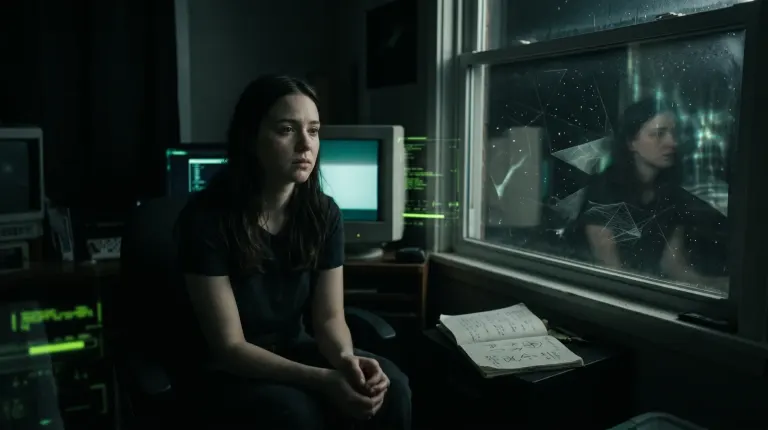
Disclosure anxiety is the stress response some people feel when UAP news, first-contact scenarios, or worldview shock starts to feel personal. It can show up as doomscrolling, chest-tight fear, sleep disruption, obsessive research, or the sense that ordinary life suddenly feels less stable.
This page does not diagnose you, and it does not claim contact is imminent. It gives you a calmer way to handle the signal without letting the signal handle you.
Why do people ask about this?
People ask about disclosure anxiety because the topic sits in an uncomfortable middle zone. It is not just entertainment. It is not fully settled science. It touches religion, identity, government trust, safety, family, and the question of whether humanity is alone.
That is heavy material for a nervous system built to handle immediate threats. When a vague future threat feels close, the body may react as if something is already in the room.
What disclosure anxiety can feel like
It may feel like pressure to know everything now. You may feel pulled into constant updates, hostile comment threads, old sightings, leaked documents, contact stories, and theories that promise certainty. The more you consume, the less settled you feel.
None of that proves you are in danger. It proves your attention has been captured by a high-uncertainty topic with emotional force.
When to get support
Safety protocol: If UAP or contact content is causing panic attacks, physical symptoms, sleep disruption, fear of harming yourself or someone else, inability to work, inability to care for family, or daily-life impairment, contact a qualified medical or mental-health professional. If there is immediate danger, use local emergency support.
Getting help does not invalidate your curiosity. It gives you command authority over your body while you evaluate the topic clearly.
What to do tonight
- Pick one trusted source window, then stop. No open-ended feed dives after midnight.
- Write the specific fear in one sentence. Vague dread gets smaller when named.
- Move your body for five minutes. Stress chemicals need an exit route.
- Tell one grounded person what is happening without asking them to believe anything.
- Use readiness training to convert anxiety into calm preparation.
What not to do
Do not force a conclusion to escape uncertainty. Do not treat every video as proof. Do not isolate yourself with content that makes you feel watched, chosen, doomed, or responsible for decoding the entire phenomenon alone.
The civilian move is smaller and stronger: stabilize, verify, document, prepare.
Common questions
What is disclosure anxiety?
Disclosure anxiety is stress, fear, or obsessive worry triggered by UAP news, first-contact scenarios, or worldview uncertainty. It is not a diagnosis.
How do I calm disclosure anxiety?
Reduce exposure, separate facts from speculation, ground the body, talk to a stable person, and use practical readiness steps instead of constant scrolling.
When should I seek professional help?
Seek qualified medical or mental-health support if the topic causes panic, physical symptoms, sleep disruption, safety risk, or daily-life impairment.
See also If a film set this off, see is Disclosure Day real? for what the record actually holds.