




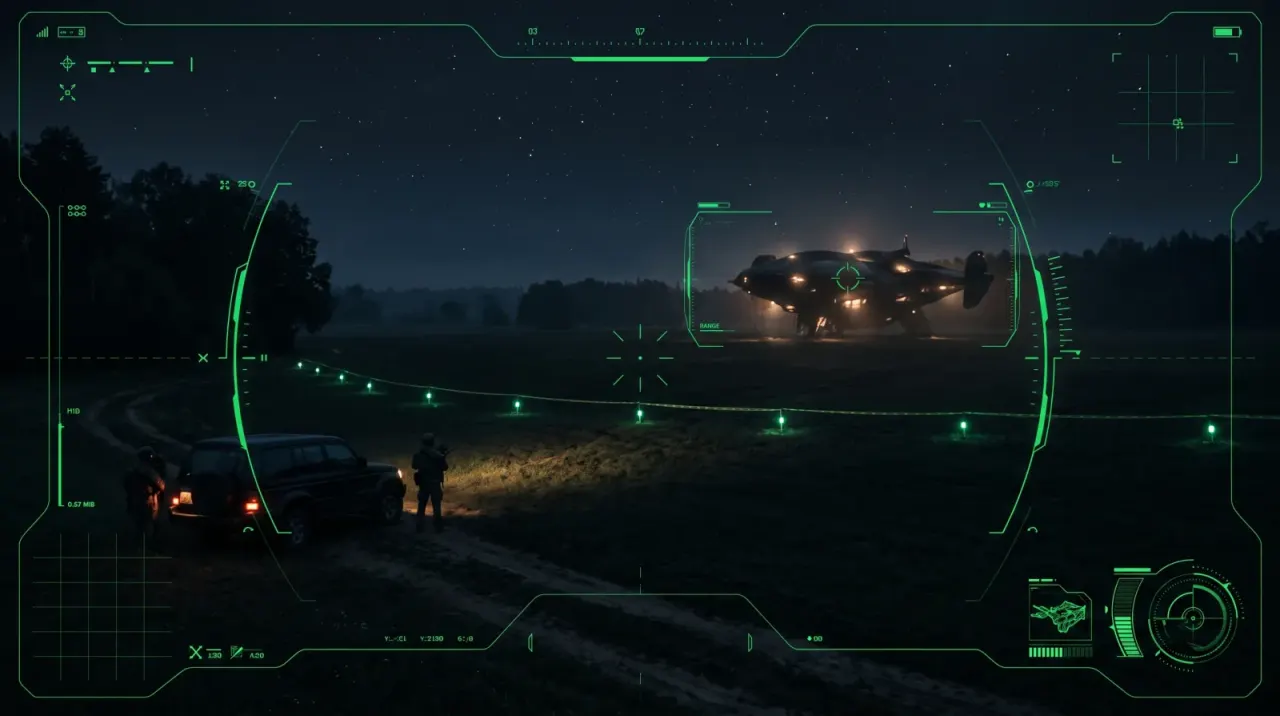
Do not approach. If an object lands nearby, create distance, record from where you are, keep other people back, document the scene, and call local authorities only if there is an immediate safety issue.
A possible landing is different from a light in the sky. The ground becomes part of the evidence. So do witnesses, roads, animals, weather, sound, and anything the object may have disturbed. Your job is not to be brave. Your job is to stay useful.
This protocol treats the event as a scenario, not a certainty. The object could be a drone, aircraft, balloon, emergency equipment, hoax, military hardware, or something still unidentified. Calm handling keeps every option testable.
Why a landed UFO changes the protocol
A sky sighting is mostly about observation. A possible landing adds proximity, ground evidence, and human behavior. People move closer because they want proof. That is exactly when evidence gets damaged and risk goes up.
Do not step into the apparent contact zone. Do not cross fences, roads, rail lines, private land, or rough terrain for a better angle. Do not touch disturbed soil, unusual residue, marks, heat sources, fluids, debris, or equipment. You do not need to assume danger to respect uncertainty.
If the object is still visible, use the wider UFO sighting protocol at the same time: record wide, narrate facts, and preserve the original file.
Set a civilian perimeter without panic
- Stop the forward movementSay one clear sentence: stay back and record from here. A calm command works better than shouting.
- Pick a boundaryUse a road edge, fence, driveway, tree line, vehicle line, or building corner as a no-cross point. More distance is better than a heroic close-up.
- Split rolesOne person records wide. One watches without a screen. One manages people. One writes notes or calls authorities if there is a real hazard.
- Keep exits clearDo not let vehicles block roads, driveways, emergency access, or each other. A contact zone should not become a traffic problem.
When should you call authorities?
Use local emergency or public safety channels for ordinary safety reasons, not because you have solved the mystery. Fire, injury, road hazard, downed wires, smoke, leaking fluid, unstable debris, trespass, aircraft risk, or a crowd losing control are valid reasons to call.
If there is no immediate hazard, document first. A calm report with original media and exact location is more useful than a frantic call with no details. The UFO reporting guide explains how to build a clean packet after the event.
What should you record?
- Scene context: object, ground, road, buildings, treeline, horizon, terrain, and witness positions.
- Time and location: local time, date, nearest address or landmark, and phone GPS if available.
- Sensory details: sound, silence, vibration, heat, cold, smell, animal behavior, and electronics behavior.
- Ground details: marks, dust, disturbed plants, water movement, light patterns, debris, or anything unusual viewed from a distance.
- People: names, contact details, separate first statements, and who recorded which angle.
Do not edit the original footage. Do not add music, captions, filters, or dramatic zoom cuts to the evidence copy. Use the UFO evidence checklist before sharing or filing anything.
How does this connect to first contact readiness?
A landing scenario tests role discipline. Sentinels may push forward to protect. Scholars may step too close for data. Diplomats may try to engage before the situation is understood. Survivors may leave without documenting. Each pattern can help or hurt.
The classification quiz identifies your default response. The First Contact briefing gives the wider civilian frame. The readiness file turns that frame into a household protocol before anyone is staring at a field.
Common questions
What should I do first if a UFO lands nearby?
Stop moving toward it, create distance, record from a safe place, keep other people back, and call local authorities if there is fire, injury, debris, road risk, or another immediate hazard.
Should I approach a landed UFO?
No. Do not approach, touch, enter, climb on, or retrieve anything from an unknown object or possible landing site. Distance protects people and preserves evidence.
Should I call emergency services for a UFO landing?
Call emergency services for immediate safety issues such as fire, injury, hazardous debris, traffic risk, trespass, or crowd control. A distant observation with no hazard can be documented first.
What should I record at a possible landing site?
Record wide context, distance, location, time, sound, light behavior, witnesses, weather, ground effects, and any ordinary explanations without stepping closer.
See also Why distance matters is shown by the Falcon Lake case, where a prospector was left with a grid of burns.