


A witness with missing time believes there is a gap between remembered experience and the clock. The gap might be minutes. It might be longer. The important move is not to rush into a theory. The important move is to stabilize the witness and preserve the timeline.
Missing time is frightening because it attacks continuity. People can handle seeing something strange. They struggle more when they cannot account for themselves inside the event.
This briefing treats missing time as a field report, not a verdict. Stress, attention, sleep, medical events, substances, dissociation, navigation errors, device glitches, and ordinary memory failure can all distort time. Some reports remain unresolved. Your job is to keep the record clean enough to know the difference.
What is missing time?
Missing time is the feeling that a period of time disappeared. In UFO and UAP reports, it is often described after a close sighting, roadside event, nighttime light, bedroom experience, or drive where the clock no longer matches the remembered route.
The phrase is loaded because UFO culture connects it to abduction claims. That connection exists in the literature and in witness stories, but it is not the only explanation. Others read it through the interdimensional hypothesis, which is no better proven. A careful civilian does not begin with the most cinematic answer. A careful civilian begins with the timeline.
Start with two anchors: the last moment you remember clearly and the first moment you remember clearly after the gap. Everything else is reconstruction.
Could there be ordinary explanations?
Yes. Time perception breaks easily under stress. People lose track of time during shock, fear, fatigue, repetitive driving, distraction, grief, panic, alcohol, medication, sleep disruption, or medical events. A phone clock can also be misread in the moment or checked only after adrenaline drops.
None of that means the witness is lying. It means memory is a recording system built out of wet electricity and survival bias. It edits. It compresses. It protects. It fills blanks if you let it.
If someone has a head injury, severe headache, chest pain, confusion, fainting, signs of exposure, or any possibility of lost consciousness while driving, stop treating the file like folklore and use ordinary medical or emergency help.
What should you do first?
Do not interrogate the witness. Do not demand a dramatic answer. Do not ask, "Were you taken?" That is a leading question and it contaminates the file.
Use neutral prompts:
- What is the last thing you remember clearly?
- What is the next thing you remember clearly?
- Where were you when you noticed the time gap?
- Who was nearby?
- What does your phone show: photos, messages, calls, steps, location, battery, alarms?
- What physical sensations or environmental details do you notice now?
The witness needs calm more than certainty. Give them water, a chair, a quiet place, and a written log. The field value comes from sequence, not pressure.
How do you document a memory gap?
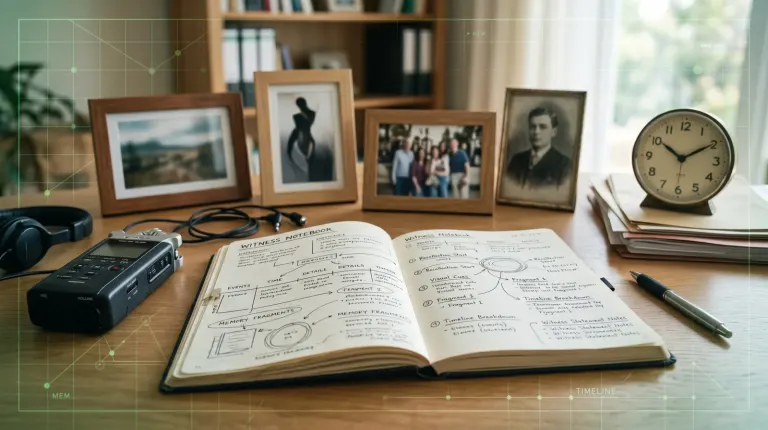
Write three columns: before, gap, after. Put only known details in the first pass. Use question marks for unknowns. Do not fill them because the blank feels uncomfortable.
- Before: location, time, direction, activity, witnesses, weather, emotional state, and what triggered attention.
- Gap: estimated missing duration, any fragments, sensations, sounds, lights, dreams, images, or body position changes.
- After: location, time, phone state, vehicle state, clothing, injuries, witnesses, messages, and first words spoken.
Save screenshots of phone location data if enabled. Preserve original photos and video. If there was a vehicle, note fuel level, mileage, dashcam status, navigation history, and parking position. If there were smart devices nearby, note logs without assuming they prove anything.
Should you use hypnosis or memory recovery?
Be careful. Hypnosis and aggressive memory recovery can create confidence without accuracy. That does not mean every recovered memory is false. It means suggestion is a weapon you can accidentally point at yourself.
Build the factual timeline first. If the experience is distressing, look for qualified mental health support, not a content creator looking for the most dramatic version of your story.
If you choose to discuss the event publicly, read how to talk about a UFO sighting first. Language can protect a witness, or it can turn them into entertainment.
How does this connect to close encounters?
Missing time is often placed under later CE4 language, but that label should not be thrown around casually. If the event began as a sighting, classify the visible encounter first. Was it a CE1 nearby object, a CE2 physical effect, or a CE3 reported presence?
Then add the memory gap as a separate layer. Encounter type and witness experience are not the same field. Keeping them separate makes the report stronger.
Use close encounter types explained to classify the event level before you classify the story around it.
What is your role after missing time?
If you are the witness, your role is not to solve the universe in one night. Your role is to protect the first account, preserve evidence, and avoid letting fear write the missing chapter for you.
If you are supporting the witness, your role is witness protection in the social sense. Keep them calm. Do not mock them. Do not sensationalize them. Do not feed details. Ask neutral questions and help them document.
DISCLOSURE archetypes matter here because stress exposes habits. The Scholar may over-interrogate. The Diplomat may over-reassure. The Sentinel may become aggressive. The Survivor may shut down. Take the classification quiz before you are standing in the blank space.
- UFO encounter psychology explains freeze, shock, and memory distortion.
- Close encounter types explained separates event level from witness interpretation.
- What to do if you see a UFO covers the first 90 seconds before a file gets messy.
- Readiness turns the briefing into calm response training.
Common questions
What is missing time after a UFO sighting?
It is a reported gap between what a witness remembers and what the clock, location data, or other people suggest happened.
Does missing time prove an abduction happened?
No. Missing time is a report that needs careful documentation. Stress, attention, sleep, medical issues, substances, and ordinary confusion can also affect memory.
What should I do first after missing time?
Check immediate safety, write a timeline before researching theories, preserve phone data, and ask witnesses for separate accounts.
Should I use hypnosis to recover missing time?
Treat hypnosis with caution. Memory can be influenced by suggestion, so build the factual timeline first and seek qualified support if distressed.
See also The most famous missing-time claim, five days in 1975, is in the Travis Walton case file. Two lost hours on a mountain road are at the center of the Betty and Barney Hill case.