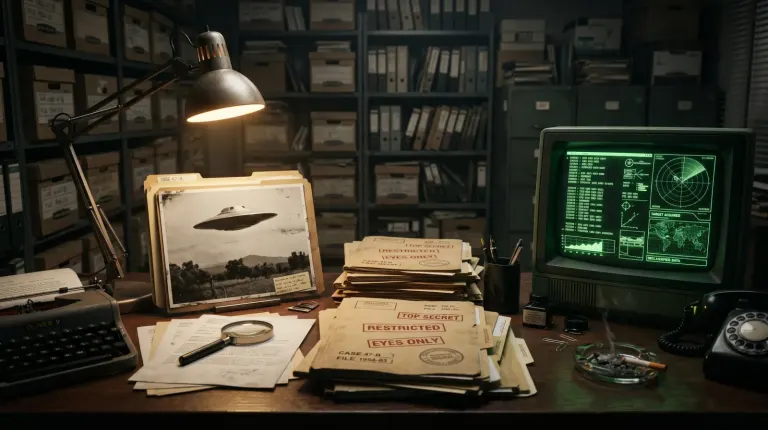

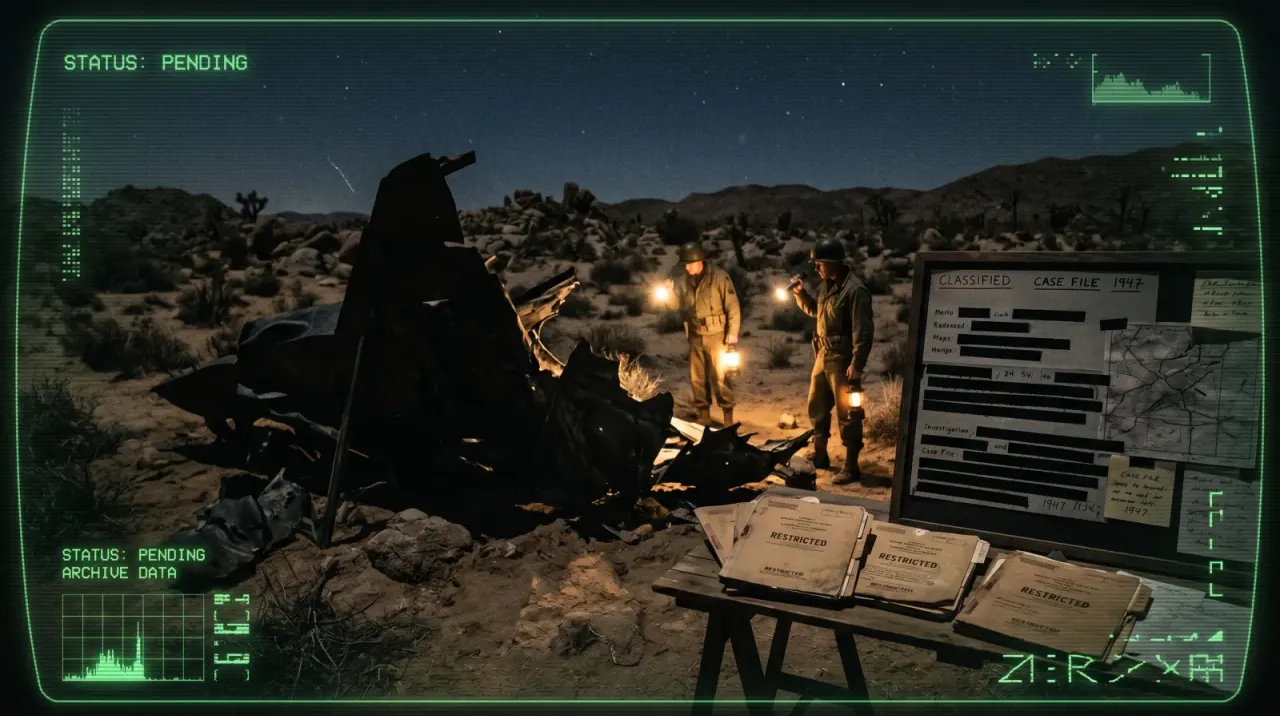
The Roswell UFO incident began in July 1947, when debris recovered from a ranch near Roswell, New Mexico became the most famous crash case in UFO history. The official record says the debris was not an alien craft. Witness claims and later retellings say the story was never that simple.
Roswell matters because it teaches the central civilian problem of disclosure: a single confusing event can split into official explanation, witness memory, media escalation, and decades of unresolved suspicion. Treat it as a case file, not a loyalty test.
What happened at Roswell?
In early July 1947, rancher W. W. Brazel reported unusual debris found northwest of Roswell. Personnel from Roswell Army Air Field recovered material from the site. The base public information office released a statement saying the Army had recovered a flying disc.
That statement was quickly walked back. Officials displayed debris and identified it as a weather balloon. Decades later, the U.S. Air Force issued reports tying the material to Project Mogul, a classified balloon program designed to detect Soviet nuclear tests.
Official record, witness claim, unresolved unknown
Official record
The public Air Force position is that the recovered Roswell debris came from a balloon system associated with Project Mogul. Later claims about alien bodies were addressed in a separate Air Force report, which argued that some memories likely blended later military dummy tests, accidents, and folklore into the 1947 story.
Witness claim
Witnesses, family members, and later researchers have claimed the material was stranger than ordinary balloon debris. Some accounts describe unusual metal, a military clampdown, intimidation, or bodies. These accounts are part of the Roswell story, but they are not all first-hand, contemporaneous, or mutually consistent.
Unresolved unknown
The unresolved part is not a proven alien crash. The unresolved part is why the initial message, secrecy around balloon work, witness distrust, and decades of inconsistent testimony created a case that official closure never fully neutralized.
Why do people ask about Roswell?
People ask about Roswell because it feels like the origin point of the modern UFO cover-up narrative. It has every ingredient: a desert crash rumor, a military base, a corrected press release, classified context, alleged witnesses, and official explanations that arrived after public suspicion hardened.
The better question is not “was Roswell real?” Something happened. The better question is what kind of evidence would be required to move the case from famous anomaly to verified non-human recovery.
What Roswell teaches civilians
- First reports matter. The first public statement can shape a case for generations, even if corrected later.
- Classification breeds mythology. A secret balloon program can make ordinary debris look like a hidden cosmic event.
- Memory is vulnerable. A witness account recorded decades later is not the same as a same-day statement.
- Official correction is not instant trust repair. When institutions reverse themselves, civilians remember the reversal.
- Famous cases still need clean evidence. Cultural weight is not proof.
How to read Roswell without getting played
Start with the public sequence. Debris was found. The military recovered it. A flying disc statement was issued. The statement was corrected. Later reports tied the debris to a balloon program. Witness claims expanded the story into crash recovery and bodies. Those folders should not be collapsed into one conclusion.
If you see a modern incident, do the opposite of Roswell folklore. Preserve original photos, write down times, keep witness accounts separate, and use a structured evidence review like the UFO evidence checklist before deciding what the case means.
How does this connect to first contact readiness?
Roswell is a readiness warning. In a confusing event, the first civilian failure is usually narrative rush. People pick a side before the record stabilizes. That is how signal turns into mythology or dismissal.
Prepared civilians stay calm, document early, separate claims, and know their role. Review the First Contact briefing, test your civilian readiness, and take the classification quiz before you need the protocol.
- Project Blue Book explained shows how later government UFO investigations handled unexplained reports.
- Government UFO programs history places Roswell in the larger public-record chain.
- UAP Records Collection explained covers how old files enter public archives.
- How to report a UFO sighting turns case history into field behavior.
- Intel briefings keeps the case files and civilian protocols together.
Common questions
What was the Roswell UFO incident?
The Roswell UFO incident was a 1947 New Mexico case where military personnel recovered debris, first described publicly as a flying disc and then identified by officials as balloon material.
Did Roswell prove aliens crashed on Earth?
No public official record proves an alien crash at Roswell. Later Air Force reports linked the debris to Project Mogul balloon equipment, while some witnesses and researchers dispute the explanation.
Why is Roswell still important?
Roswell matters because it shows how official reversals, secrecy, witness claims, and public distrust can turn one confusing event into a long-running disclosure symbol.
See also Six more famous cases, each labeled explained, disputed or unexplained, are in the UFO case files. For a crash-style case where the government file still says unsolved, read the Shag Harbour incident of 1967.