
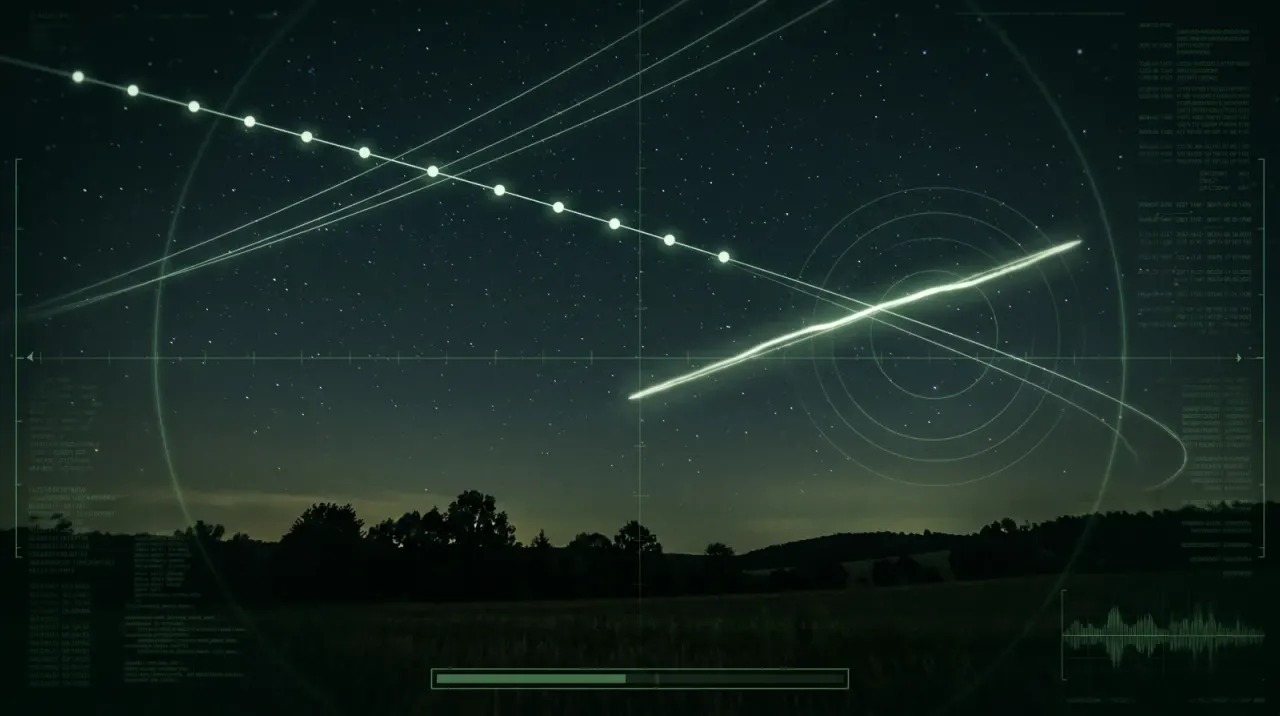

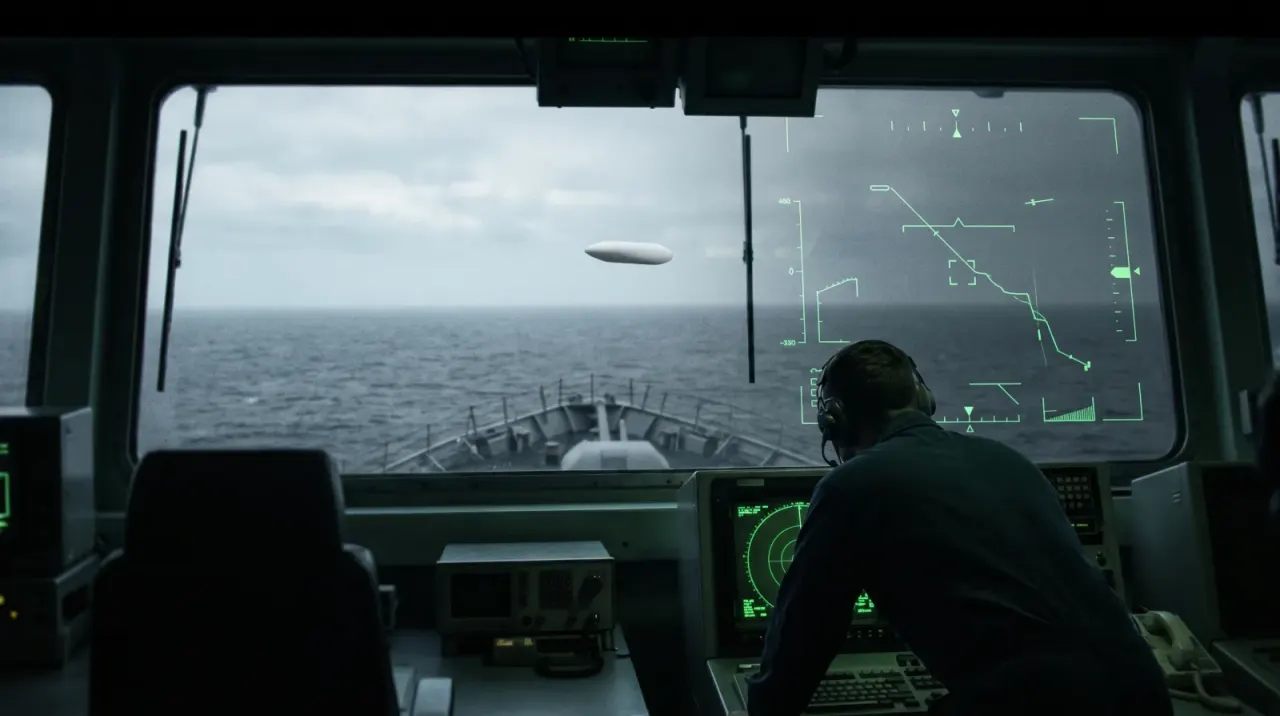
The Nimitz Tic Tac UFO case is a 2004 U.S. Navy encounter off the coast of Southern California that the public record still leaves unresolved. Radar operators and fighter pilots reported an object described as a smooth white Tic Tac, and the Navy later acknowledged related videos as authentic Navy footage without identifying the object.
It is one of the strongest modern UAP cases in the public conversation because trained military witnesses and sensor context are part of the record. It still does not prove origin. Witness claims describe extraordinary performance. The missing public data prevents civilians from closing the file with certainty.
What was the Nimitz Tic Tac case?
During training operations in November 2004, personnel from the Nimitz carrier strike group investigated unusual tracks reported by radar operators. Navy pilots, including Commander David Fravor, later described seeing a white, wingless object near a disturbance on the ocean surface.
The object was described as smooth, roughly Tic Tac-shaped, and capable of rapid movement. A related infrared video, often called FLIR1, became part of the public UAP discussion years later.
Official record, witness claim, unresolved unknown
Official record
The U.S. Navy acknowledged that several widely circulated videos showed unidentified aerial phenomena and were authentic Navy footage. The government has treated the Nimitz incident as part of the modern UAP record, but public releases do not identify the object’s origin.
Witness claim
Pilots and personnel have described radar tracks, rapid descent, unusual acceleration, no visible wings, no exhaust plume, and behavior unlike known aircraft. Those claims make the case important, especially because they come from trained military observers.
Unresolved unknown
The unresolved part is the full data chain. Civilians do not have all raw radar, sensor, operational, and intelligence context. Without that, the case can be treated as highly significant and still not converted into a proven non-human craft.
Why do people ask about the Tic Tac UFO?
People ask about this case because it moved UAP from late-night folklore into mainstream military and congressional discussion. It has pilots, warships, sensor claims, and video. That combination feels harder to dismiss than a single witness account.
It also became a test case for modern disclosure. If even a military encounter with multiple reported data streams remains unresolved publicly, civilians need better tools for evaluating claims without filling gaps with fantasy.
What makes this case different?
- Military witnesses. The public discussion includes trained pilots and Navy personnel.
- Sensor context. Radar and infrared references make the case more structured than ordinary sightings.
- Official acknowledgment. The Navy confirmed the videos were authentic Navy footage, not internet fabrications.
- Unknown origin. Public acknowledgment of footage is not public identification of the object.
- Disclosure impact. The case helped push UAP into hearings, reports, and public offices.
What should civilians learn from it?
The Nimitz case teaches disciplined escalation. A serious report deserves serious handling. It does not deserve instant mythology. If you record a strange object, preserve the original file, note weather and aircraft context, and write down what you saw before watching other commentary.
For public evidence review, use the UFO evidence checklist, drone vs UFO, and the Rio Scale briefing to separate significance from certainty.
How does this connect to first contact readiness?
Modern UAP cases train a key civilian reflex: hold uncertainty without losing function. You may see something serious before institutions explain it. Your job is not to solve physics on the sidewalk. Your job is to preserve signal.
Start with the First Contact briefing, assess readiness, and take the classification quiz so your first reaction has a role instead of panic.
- What is AARO? explains the modern Pentagon UAP office.
- NASA UAP report explained covers the data-first approach to unresolved objects.
- UAP disclosure timeline shows how cases feed public policy pressure.
- How to film a UFO at night turns a sighting into usable evidence.
- Intel briefings holds the wider UAP field library.
Common questions
What is the Nimitz Tic Tac UFO case?
It is a 2004 U.S. Navy UAP case involving the USS Nimitz carrier strike group, unusual radar tracks, pilot observations, and a white Tic Tac-shaped object reported off Southern California.
Did the Navy say the Tic Tac was alien?
No. The Navy acknowledged related UAP videos as authentic Navy footage, but public records do not identify the object as alien or non-human.
Why is the Nimitz case important?
It is important because trained military witnesses, sensor context, and official video acknowledgment make it one of the strongest modern unresolved UAP cases in public discussion.
See also The infrared clip from that day, and what AARO has said about it, is in the Gimbal, GoFast and FLIR case file. A later military video that AARO did resolve is the Jellyfish UFO from Iraq.