

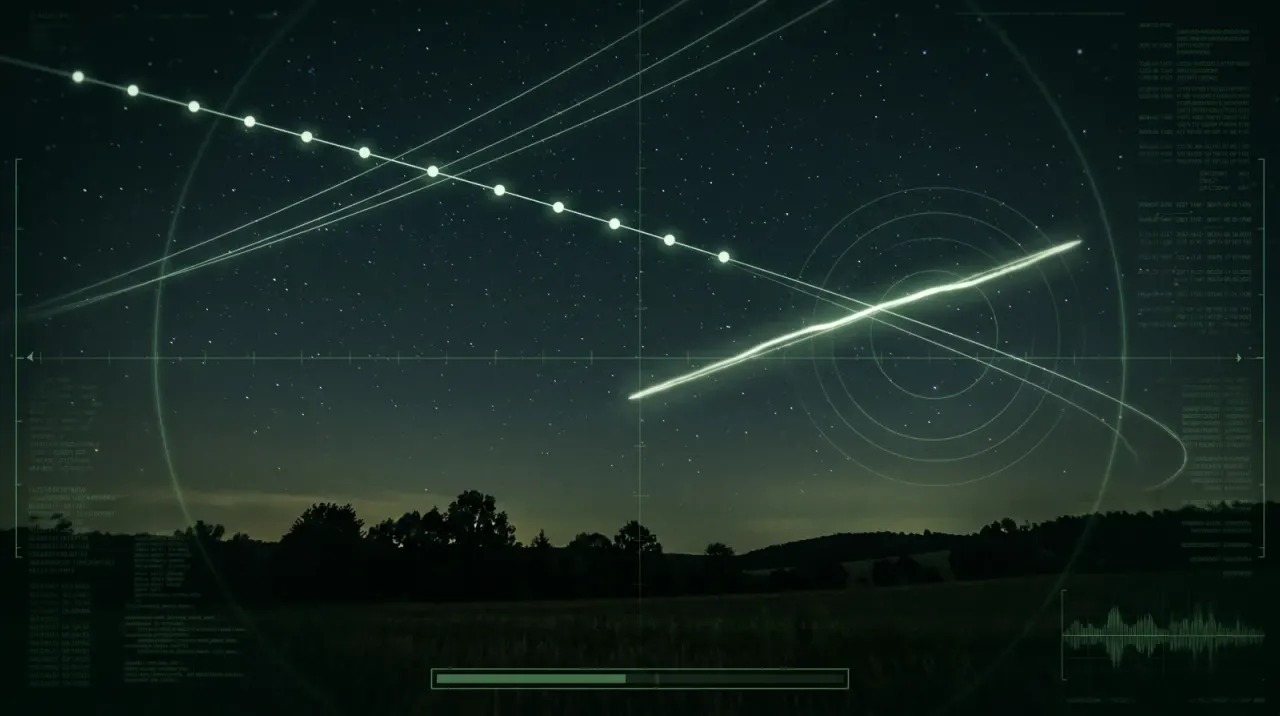

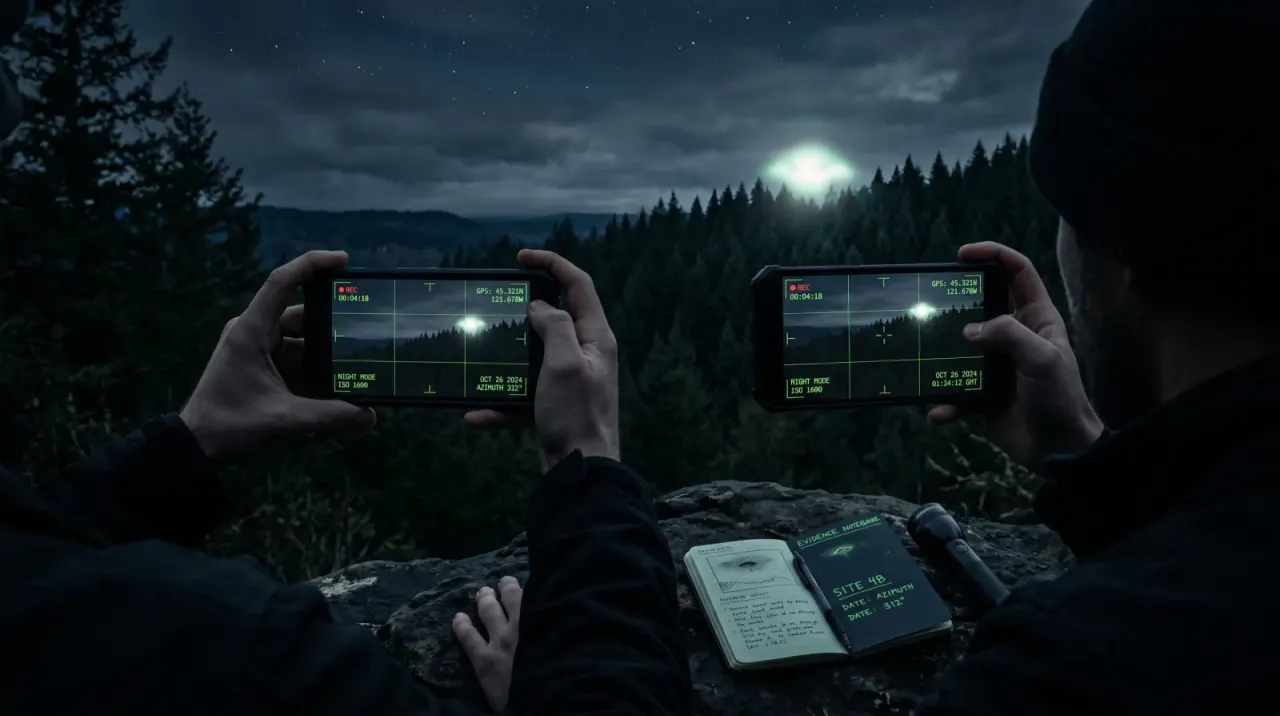
Night UFO footage is only worth something if it protects context, so forget the perfect close-up. Record wide first, stabilize your phone, keep fixed reference points in frame, narrate facts, and preserve the original file before any edits or uploads.
Night footage fails fast. A bright dot on black sky can be a satellite, aircraft, drone, planet, balloon, reflection, insect near the lens, or something still unidentified. The only useful move is to film in a way that lets someone test the event later.
This is a civilian field protocol. It will not turn every strange light into proof. It will keep you from destroying the details that make a sighting worth reviewing.
Why night UFO footage usually fails
At night, the sky removes scale. Distance collapses. A nearby drone can look distant. A distant aircraft can look still. Digital zoom turns stars into pulsing blobs. Autofocus hunts. Hand shake makes ordinary motion look impossible.
That does not mean the witness is wrong. It means the recording needs discipline. A stable wide shot with reference points beats a shaky close-up every time.
If the event is happening now, use the base protocol in what to do if you see a UFO. If your phone is already up, follow this capture order.
Set the phone before the sky gets weird
- Lock your body firstUse two hands. Brace elbows against your ribs. Lean against a car, wall, fence, tree, or railing. Stability is evidence.
- Start wideInclude horizon, rooftops, mountains, treeline, streetlights, stars, clouds, or power lines. The object needs a world around it.
- Zoom only after contextGet at least ten seconds of wide footage first. Then zoom slowly if needed. Return to wide shots during the event.
- Avoid filters and night tricksDo not add exposure filters, social camera effects, stabilization apps, or color correction while recording the evidence copy.
- Keep rolling after it leavesFilm the empty sky, nearby aircraft, clouds, streetlights, animals, witnesses, and surroundings. Aftermath can explain or strengthen the file.
What should you say out loud?
Narration helps because memory shifts under stress. Speak like a field recorder, not a commentator. Use plain facts and leave room for uncertainty.
- Time: local time, date, and how long the object has been visible.
- Location: nearest town, road, landmark, or coordinates if available.
- Direction: where you are facing and where the object moves.
- Sound: engine, buzzing, silence, rumble, wind, traffic, dogs, or people.
- Motion: straight path, hover, drift, pulse, blink, descent, climb, turn, or disappearance.
- Witnesses: how many people see it and whether anyone has another angle.
Do not say it is definitely non-human, definitely military, or definitely impossible unless the file actually proves that. Careful language keeps the record usable.
What should you not do while filming?
Do not chase the object into traffic, private property, rough terrain, or unsafe weather. Do not shine lasers at anything in the sky. Do not approach debris. Do not let a crowd form around a phone screen while the event is still happening.
Do not edit the only copy. Do not post the raw file before saving it. Do not send the only original through an app that compresses video. Make duplicates and keep the source file clean.
Use the UFO evidence checklist after the event. It catches missing details before the footage becomes a social caption.
How do you check the footage afterward?
Start with ordinary explanations. That is not surrender. It is protection. A sighting that survives aircraft, drones, satellites, planets, balloons, reflections, weather, and camera artifacts becomes more interesting.
- Compare the object path with aircraft routes, drone behavior, and satellite movement.
- Check whether the light appears only when the camera moves or zooms.
- Look for blinking patterns, engine sound, straight silent travel, wind drift, or repeated passes.
- Ask witnesses to write separate accounts before group discussion changes the memory.
- Keep weather notes, screenshots, maps, and original file details in one folder.
If the object may have been a satellite train, use Starlink vs UFO. If it was low, hovering, blinking, or buzzing, use drone vs UFO. If you need the whole boring filter, use airplane, satellite, balloon or UFO.
How does night filming fit first contact readiness?
First contact readiness starts with calm behavior under surprise. Your role is not to produce a viral clip. Your role is to keep people safe, keep evidence intact, and avoid turning uncertainty into panic.
The First Contact briefing explains the wider civilian frame. The readiness file turns it into household protocol. The classification quiz identifies whether your default response is protector, communicator, analyst, or something stranger.
- Intel index keeps the public briefing archive in one place.
- How to report a UFO sighting turns raw footage into a clean report packet.
- What are orbs in the sky? helps evaluate bright round lights before making claims.
- UFO encounter psychology explains why witnesses freeze, fixate, or misremember under stress.
Common questions
What is the best way to film a UFO at night?
Start wide, keep the horizon or fixed objects in frame, brace your phone, narrate time and direction, preserve the original file, and avoid filters or heavy digital zoom.
Should I zoom in on a UFO at night?
Zoom only after you record wide context. A close light with no horizon, buildings, trees, stars, or reference points is usually weak evidence.
What should I say while recording a night UFO sighting?
Say the time, location, direction faced, weather, sound, movement, witness count, and what normal explanations you are checking. Do not narrate a conclusion.
What should I do with the video after filming?
Save the original file untouched, make a duplicate for sharing, write notes immediately, check ordinary explanations, and keep everything in one incident folder.
See also Keep the original file, then log it in the sighting report form. Before you film a blinking light, ask what is that flashing light in the sky.