
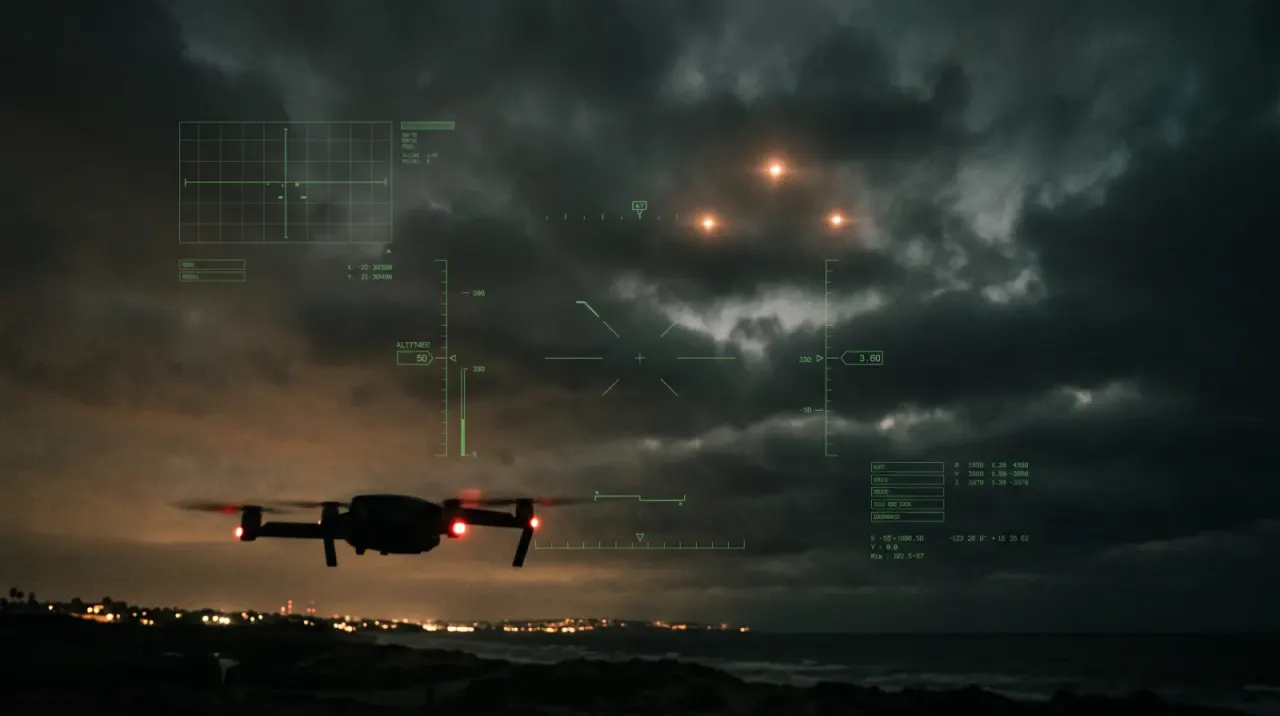
Altitude, sound, light pattern, motion, duration, and safety context separate most drones from genuine unknowns. Many drone sightings look strange at night because the body disappears and only the lights remain.
A drone can hover, turn sharply, blink, change altitude, and move in ways that feel unnatural if you cannot hear it clearly. A careful witness does not jump from "strange" to "unknown." A careful witness runs the low-altitude filter first.
This guide helps civilians separate likely drone behavior from sightings that deserve deeper review, while keeping people safe and the evidence intact.
Why drones get mistaken for UFOs
Drones can break the old witness rules. They hover. They move sideways. They stop. They climb and descend. They can carry bright lights. At a distance, the rotor sound may vanish under traffic, wind, water, or crowd noise.
At night, your brain tries to estimate distance from a light with almost no context. A small drone close to you can look like a larger object far away. A larger professional drone can look even stranger.
That does not mean every low light is a drone. It means drone belongs near the top of the boring list.
Signs the object may be a drone
- Low altitude: below cloud level and visually near trees, rooftops, towers, or hills.
- Hovering: stationary pauses followed by controlled lateral movement.
- Light pattern: blinking red, green, white, or colored LEDs, sometimes changing orientation.
- Sound: buzzing, whine, rotor chop, or pitch changes when it accelerates.
- Short duration: a limited flight window, then descent, departure, or lights out.
- Operator context: nearby event, construction, search activity, photography, property inspection, or hobby area.
If the sighting is mostly a bright point high overhead, use Starlink vs UFO or the wider misidentification guide instead.
Signs it deserves more review
A drone explanation weakens when the object appears very high, silent at close range, extremely fast, unaffected by wind, present for a long time, or moving in ways that do not fit known local drone activity.
- No obvious rotor sound despite apparent proximity and quiet surroundings.
- Acceleration or climb rate that seems beyond a small drone, with reference points visible.
- Long duration without descent, battery pause, operator recovery, or route repetition.
- Multiple objects coordinating without normal formation or event context.
- Environmental effects, interference, or witness reports from multiple angles.
Do not overclaim. Just mark the drone check unresolved and keep documenting.
How to record a possible drone safely
- Stay out of the pathDo not chase it, block roads, trespass, or stand under a low object. Safety beats footage.
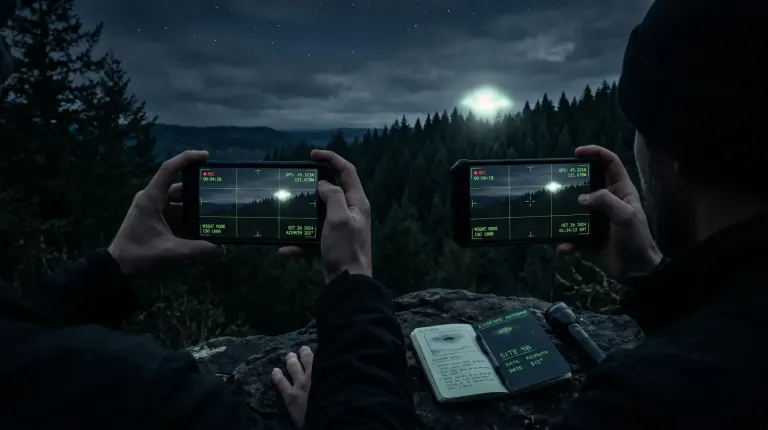
- Record wide contextFrame trees, rooftops, hills, power lines, towers, roads, or people for altitude and scale.
- Capture audioStop talking for a few seconds. Let the phone record wind, traffic, buzzing, animals, or silence.
- Track the routeNote whether it repeats a pattern, returns to a launch area, follows a property line, or descends.
- Preserve the originalSave the raw file, write notes immediately, and keep witness accounts separate before group debate.
When should you call authorities?
Use local public safety channels for immediate risk: airport or aircraft concern, crash or debris, fire, injury, harassment, suspicious activity near restricted infrastructure, traffic hazard, or crowd control. Do not create your own emergency by pursuing the object.
Do not shine lasers at aerial objects. Do not throw anything. Do not interfere with aircraft. Do not approach wreckage or unknown equipment. Record from a safe place and document what happened.
For non-emergency documentation, move through how to report a UFO sighting after the event.
How this fits first contact readiness
First contact readiness includes resisting the urge to escalate every unknown. A Sentinel might chase the perimeter. A Scholar might over-focus on the object. A Diplomat might manage the crowd. The correct role depends on risk.
The First Contact briefing gives the civilian frame. The readiness file turns it into safer behavior. The classification quiz identifies the reflex you bring to a low-altitude event before adrenaline assigns it for you.
Common questions
How can I tell if a UFO is actually a drone?
Look for low altitude, hovering, buzzing, blinking navigation lights, short operating time, nearby operator activity, and movement that fits consumer or professional drone behavior.
Can drones look like UFOs at night?
Yes. At night, drones can appear as silent or nearly silent lights, hover in place, change direction quickly, and confuse distance because there are few reference points.
What should I not do near a suspicious drone?
Do not chase it into danger, trespass, throw objects, shine lasers, or approach possible crash debris. Record from a safe position and report immediate hazards to local authorities.
When should a drone-like sighting be reported?
Report immediate safety concerns, restricted-area activity, airport risk, harassment, crash debris, or crowd danger through proper local channels. Non-emergency unknowns can be documented later.
See also If it moved steadily and never blinked, rule out a satellite first. Balloons fool trained operators too, as the Jellyfish UFO case shows. For what happens when a whole state starts reporting drones, read what the New Jersey drones were. Not every blinking light is a drone: see flashing lights that are not drones. A warm glow that drifts is more often a lantern, as orange lights in the sky explains.