
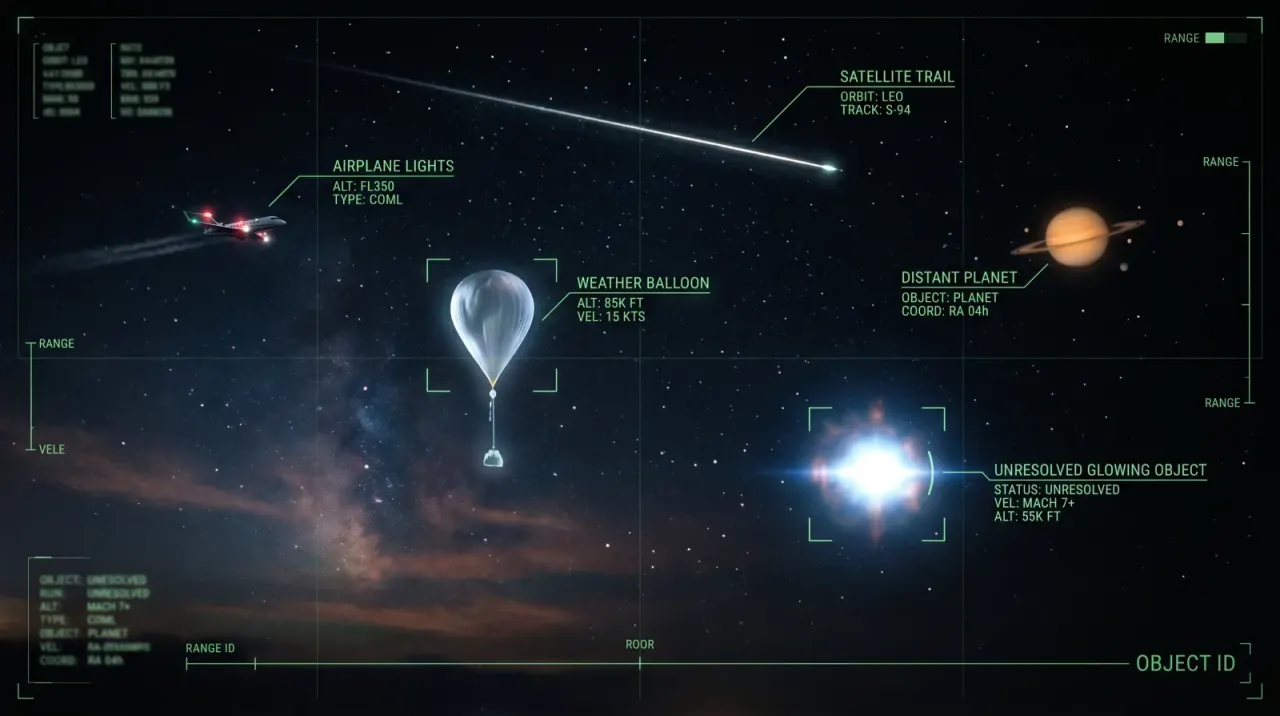
Airplane, satellite, balloon or UFO? That is the filter every civilian witness should run before deciding a sighting is truly unknown. Most sky events have ordinary explanations. Some do not. The difference depends on context, not excitement.
Misidentification does not mean stupidity. It means the sky is hard to read. Darkness removes scale. Distance flattens motion. Wind changes paths. Cameras add artifacts. Stress turns seconds into a story.
This guide gives you a practical decision tree for common UFO misidentifications, so your report gets stronger instead of louder.
Why misidentification happens
The human visual system was not built for night-sky forensics. It wants fast meaning. A light moves, the body reacts, the mind fills the missing scale. Then the group starts talking and the memory begins to merge.
Phones add another layer. Digital zoom, stabilization, rolling shutter, autofocus, reflections, dirty glass, compression, and low-light processing can create motion or shape that was not visible to the eye.
Use the filter before the story hardens.
Airplane or UFO?
Aircraft are one of the most common sources of strange night lights. A plane flying toward you can appear to hover. Landing lights can look like a bright orb. Navigation lights can blink in patterns that feel deliberate.
- Likely aircraft: red, green, or white blinking lights, steady path, engine sound, known route, gradual approach or departure.
- Watch for illusion: an aircraft pointed toward you may look stationary until the angle changes.
- Worth more review: sudden stop, sharp turn, impossible acceleration, silence at close apparent range, or motion inconsistent with reference points.
Record wide before zooming. A light without horizon or reference points cannot defend itself.
Satellite, Starlink or UFO?
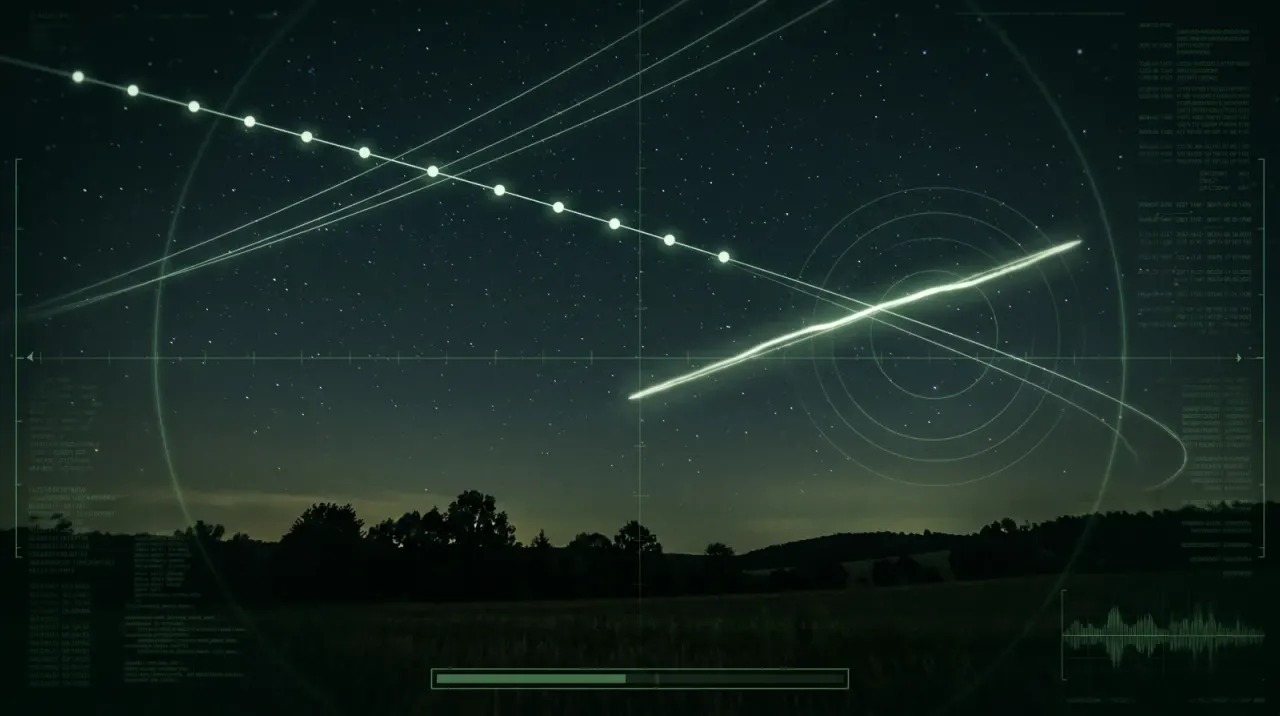
Satellites usually move smoothly across the sky in a straight path. They do not hover, turn sharply, descend, or react to the ground. They are silent. They may brighten, dim, or disappear as sunlight angle changes.
Starlink can appear as a line or train of lights moving together. If your sighting was a chain, use Starlink vs UFO before filing it as unknown.
- Likely satellite: steady speed, smooth path, silent, high overhead, fade into shadow.
- Likely Starlink: multiple lights in a line, same direction, same speed, formation fades or passes.
- Worth more review: hovering, low altitude, sharp turns, independent movement, sound, or environmental interaction.
Balloon, lantern or UFO?
Balloons, lanterns, and wind-carried objects can drift silently and glow or reflect light. They may look intelligent because wind at different heights can shift direction. A balloon can appear to pause when it moves toward or away from you.
- Likely balloon: slow drift, wind direction match, changing brightness, no sound, no powered turns.
- Likely lantern: warm glow, slow rise, drift, dimming or extinguishing.
- Worth more review: high-speed movement, repeated route against wind, sudden acceleration, or structured behavior with multiple angles.
Check local events, weddings, festivals, sports nights, weather, and wind. Boring context solves many dramatic clips.
Drone, planet, reflection or camera artifact?
Drones are the low-altitude wildcard. Planets and stars are the stationary trap. Reflections and camera artifacts are the phone trap.
- Drone: hover, buzz, blink, move laterally, descend, repeat paths, operate near people or events.
- Planet or star: appears fixed, pulses through atmosphere, seems to follow you when you move.
- Reflection: appears through glass, near bright lights, or changes with camera angle.
- Insect or dust: close to lens, out of focus, bright under flash or infrared, moves with tiny chaotic motion.
- Autofocus or zoom artifact: shape changes when the camera hunts, stabilizes, or digitally enlarges the light.
Use drone vs UFO for low objects. Use what are orbs in the sky for bright round lights.
The civilian decision tree
- Stabilize the witnessGet safe. Breathe. Keep distance. Do not chase, trespass, or create a traffic hazard.
- Record contextFilm wide with horizon, structures, trees, stars, clouds, roads, and sound. Context is the filter.
- Run the boring listAircraft, drones, satellites, planets, balloons, weather, reflections, insects, and camera effects.
- Preserve originalsSave raw files, write first notes, separate witnesses, and keep checks in one incident folder.
- Mark status honestlyResolved, likely ordinary, unresolved with weak evidence, or unresolved with strong evidence. Do not inflate the label.
What if it stays unresolved?
Unresolved does not mean extraordinary. It means unresolved. That is still useful when the file is clean, the witness notes are fresh, and the common explanations have been checked.
Move from identification to documentation with the UFO evidence checklist, then file the packet using how to report a UFO sighting. If you need capture discipline first, read how to film a UFO at night.
Why this matters for readiness
First contact readiness is not believing everything. It is staying functional when the category is unclear. A prepared civilian can protect people, preserve evidence, and say "I do not know yet" without losing control.
The First Contact briefing explains the civilian frame. The readiness file turns the behavior into household protocol. The classification quiz shows which role you default to when the boring list fails.
Common questions
What objects are most often mistaken for UFOs?
Common misidentifications include aircraft, drones, satellites, Starlink trains, planets, stars, balloons, lanterns, weather effects, reflections, insects near the lens, and camera artifacts.
Can an airplane look like it is hovering?
Yes. An aircraft flying toward you can appear nearly stationary, especially at night when distance and direction are hard to judge.
How do I tell a satellite from a UFO?
Satellites usually move smoothly in a straight path, stay silent, do not hover, and may fade as they enter shadow. Unusual maneuvering or low-altitude behavior deserves more review.
Does misidentification mean the witness is lying?
No. The sky is difficult to interpret under stress, darkness, distance, weather, and camera zoom. Misidentification is a normal human problem, not a character flaw.
See also Before you decide, run your sighting through the sky identifier: it checks satellites, planets and bright stars for your time and place. Colour narrows it fast: what is that green light in the sky covers the green ones. For a light that blinks, use the ten-second flash count.