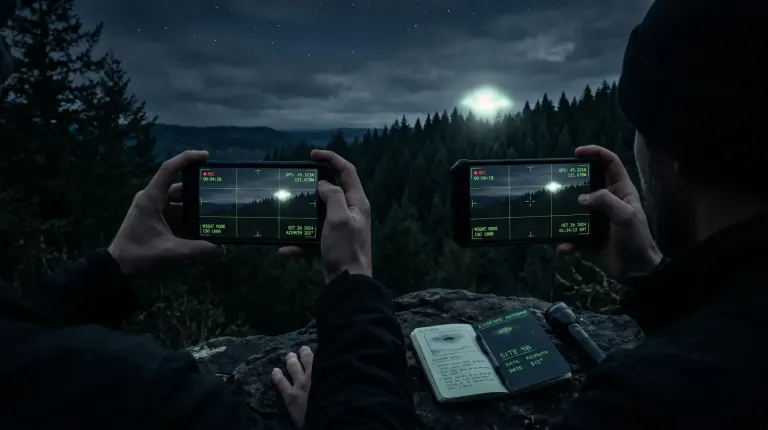


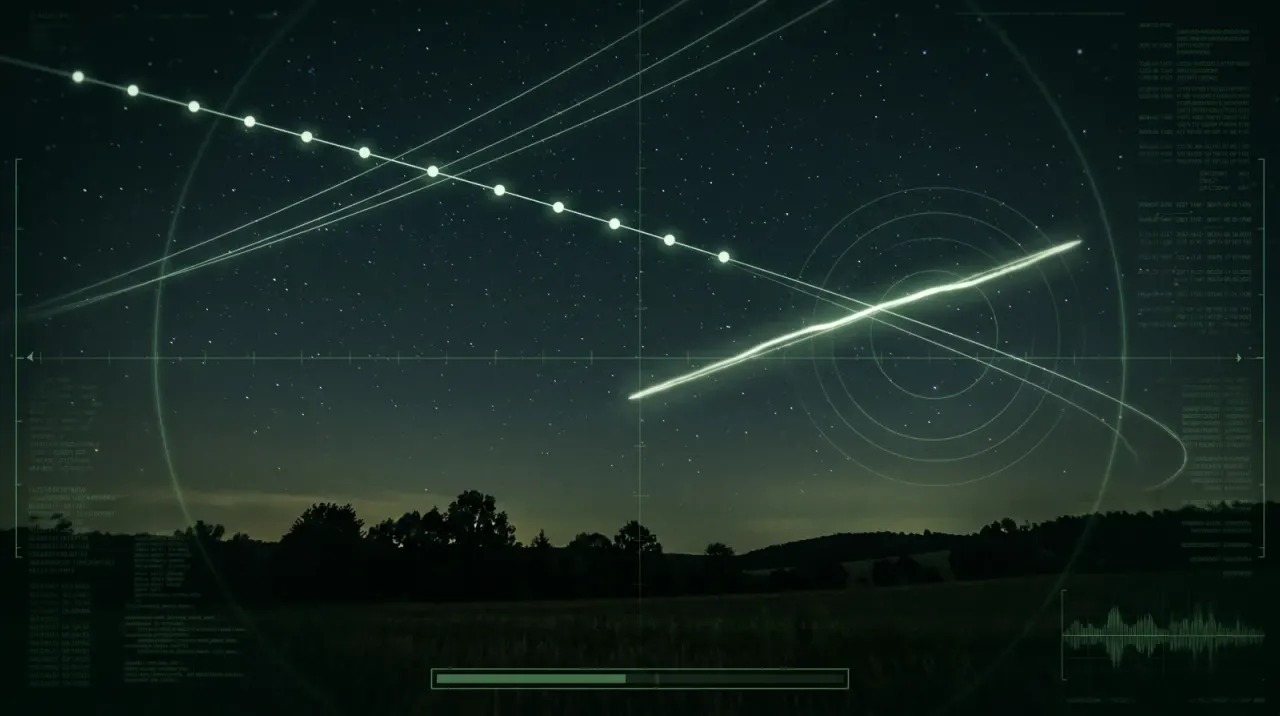
A Starlink satellite train often appears as a line of lights moving together in a smooth path, usually silent, usually steady, and sometimes fading as the satellites move into shadow. It is one of the most common night-sky confusion points.
A UFO or UAP sighting is not proven by surprise. It is what remains after normal explanations are checked. Starlink should be near the top of that checklist for any string, row, or cluster of lights crossing the night sky.
The civilian move is simple: observe the pattern, document the path, check the timing, and do not turn a satellite train into a contact event because it looked strange for thirty seconds.
Why Starlink gets mistaken for UFOs
Starlink trains are visually unnatural if you are not expecting them. Most people know what a single satellite looks like. Fewer expect a chain of bright points crossing the sky in formation.
Freshly deployed satellites can appear closer together. Atmospheric conditions, local darkness, camera exposure, and witness adrenaline can make the formation look larger, brighter, or stranger than it is.
That is why the first question is not "is this alien?" The first question is whether the movement behaves like orbital hardware.
Signs the object may be Starlink
- Line formation: a train, string, or sequence of lights crossing the sky.
- Same speed: each light moves together instead of independently maneuvering.
- Smooth path: no hovering, sharp turn, sudden stop, descent, or zigzag.
- Silence: no engine, buzzing, rotor sound, rumble, or local disturbance.
- Fading: lights dim or vanish as they enter shadow or change viewing angle.
- Short window: the event lasts seconds to minutes, then the formation is gone.
If your footage is just a row of lights moving steadily across the sky, do not skip the satellite check. Use the UFO evidence checklist before naming it unknown.
Signs it may not be Starlink
Not every light formation is Starlink. The filter cuts false positives. It does not explain every case.
- Objects separate, regroup, hover, or change direction independently.
- The formation appears low, close to terrain, or affected by wind and local obstacles.
- You hear rotor noise, engine sound, buzzing, or a nearby launch source.
- The lights pulse in aircraft or drone patterns rather than reflecting sunlight.
- The object descends, stops, accelerates sharply, or interacts with clouds, trees, power, animals, or people.
- Multiple witnesses capture the same object from different angles and the geometry does not fit a high-altitude pass.
If the sighting is low, hovering, or audible, run the drone vs UFO filter next. If it is a single light with little context, read what are orbs in the sky.
How to document a possible Starlink pass
- Film wideInclude horizon, rooftops, mountains, stars, or trees. A line of lights needs direction and scale.
- Narrate directionSay where the formation starts, where it moves, and whether the lights keep the same spacing.
- Record the fadeKeep filming until the lights disappear. A smooth fade can be more useful than the bright portion.
- Check timing laterCompare the time, direction, and path with satellite visibility tools or public launch information after preserving the original file.
- Keep language neutralWrite "line of lights moving northeast" before you write "craft" or "formation." The record should survive review.
What if the Starlink check does not fit?
If the event does not match a satellite train, stay calm and keep building the file. Preserve the original footage. Write first notes. Separate witnesses. Check aircraft, drones, balloons, planets, weather, reflections, and camera effects.
Use airplane, satellite, balloon or UFO for the full misidentification stack. If the event still holds, route it through how to report a UFO sighting.
Why this matters for first contact readiness
Readiness is not panic in a classified jacket. It is knowing what to eliminate before the crowd starts telling a story. A calm witness protects the signal by removing noise.
The First Contact briefing explains why civilian behavior matters before certainty arrives. The readiness file gives you a steadier household response. The classification quiz shows whether you are likely to secure, communicate, analyze, or freeze when the sky refuses to be boring.
Common questions
How do I know if I saw Starlink or a UFO?
Starlink often appears as a line or train of lights moving in the same direction at the same speed. It is usually silent, travels smoothly, and may fade as satellites enter Earth shadow.
Can Starlink look like a UFO?
Yes. Shortly after satellite deployment, Starlink trains can look strange, especially to witnesses who have never seen a chain of lights crossing the sky.
What makes a sighting less likely to be Starlink?
Sharp turns, hovering, sudden acceleration, erratic movement, low altitude behavior, sound, interaction with the environment, or multiple independent angles can make the sighting deserve more review.
Should I report a Starlink sighting?
If the object clearly matches a satellite train, keep notes but avoid filing it as unknown. If details do not match and you preserved evidence, build a calm report packet.
See also Saw a line of lights? Check what was overhead at that minute with real Starlink and satellite positions. Single glints and strobes are covered in Starlink flares and other flashing lights.