The Falcon Lake incident is the case of Stefan Michalak, a Winnipeg mechanic who said a landed craft burned his chest near Falcon Lake, Manitoba, on 20 May 1967. The RCMP could not account for his burns or resolve the gaps in his story. National Defence lists the case as unsolved.
Case 007May 1967Manitoba, CanadaDisputed
File CSE-007 / Falcon Lake / UnclassifiedReleased in partCivilian copy
Case file CSE-007Summary sheet
Case summary
Date
20 May 1967, around midday by Michalak’s accounts. He flagged down an RCMP highway patrol car on the Trans-Canada Highway at about 3:00 pm.
Place
Bush north of Falcon Beach in Whiteshell Provincial Park, Manitoba, about 150 km east of Winnipeg. The RCMP later placed the site about 2.5 miles north of the highway.
Witnesses
One: Stefan Michalak, 51, an industrial mechanic and weekend prospector. The University of Colorado investigator found that a nearby fire tower lookout saw nothing unusual.
Duration
About half an hour or more on the ground by his accounts, then a sudden takeoff. The RCMP inquiry ran from 23 May to August 1967.
Evidence
Burns to his chest and abdomen, a burned undershirt and melted cap, a 15-foot circle on the rock where moss was missing, and soil from a rock crack that tested radioactive.
Official finding
RCMP, August 1967: some facts cannot be denied and cannot be accounted for or explained away, and the inconsistencies were never resolved. (RCMP file, Library and Archives Canada) The archives’ exhibition says National Defence identifies the Falcon Lake case as unsolved.
Status
Disputed
National Defence lists it as unsolved. The RCMP could not account for the burns, and it also recorded discrepancies it never resolved. There is no second witness.
What happened
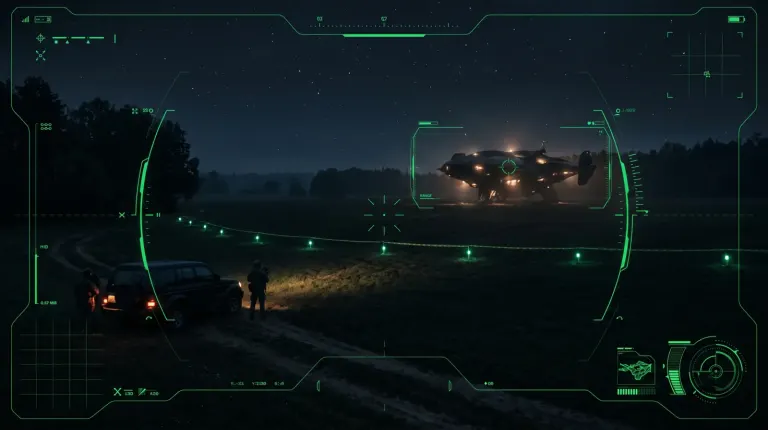
On Saturday 20 May 1967, Stefan Michalak, a Winnipeg industrial mechanic who prospected on weekends, was working a quartz vein in the bush north of Falcon Beach, Manitoba. By his account, a flock of geese startled him and he looked up to see two glowing objects descend. One landed on a flat rock and the other flew off. He sketched the landed craft for about half an hour, then walked up to it, heard what he took to be muffled voices and called out in several languages, CBC reports.
He said a hatch closed, and when he touched the hull with a gloved hand the fingertips of the glove melted. As the craft turned, a blast of hot gas from a panel of holes set his shirt and cap on fire. He tore off the burning shirt and left it at the scene. That is his account, as summarized by Library and Archives Canada.
At about 3:00 pm he flagged down an RCMP highway patrol constable. The constable’s version, in the RCMP report of 26 May 1967, is that Michalak said he had seen two space ships and been burned touching one, but refused to show his shirt or say where it happened. He took a bus to Winnipeg that evening, and his son took him to the Misericordia Hospital emergency department. He told the intern the burns came from aircraft exhaust because, he later told police, he expected no one would believe the truth.
What the evidence is
Falcon Lake is unusual because the police file survives. Library and Archives Canada put two RCMP reports online, the 26 May report and the 10 August report, with Ottawa memos attached. The links here point to archived copies of those files.
The burns. On 23 May, two RCMP investigators saw a burn about a foot across on his abdomen, “blotchy and with unburned areas inside the burned perimeter area.” His family doctor found nothing wrong with him mentally, and enquiries at three psychiatric hospitals found no record.
The clothing. His undershirt smelled of burned electrical wiring to both officers, and the front of his cap was melted. A Winnipeg clinic checked the undershirt, cap and burn and found no radioactive material.
The site. A helicopter search on 25 May, guided by an area he marked on a map, and a search on foot with him on 1 June both failed to find it. On 25 June he returned with Gerald Hart, a man he said he had not met before, found the spot, and took away shirt remnants, a steel tape and soil, after the RCMP had asked him not to remove evidence.
The radiation. Laboratory tests in Ottawa found that soil highly radioactive, and Health and Welfare sent radiation specialist Stuart Hunt. On 28 July, Hunt found radiation only in a crack in the rock across the centre of a 15-foot circle where the moss was missing. It was radium 226, and he judged the small quantity no danger to people passing through.
The University of Colorado UFO study also sent an investigator. Its Case 22 report records that a watchman in a nearby fire tower noticed nothing unusual that day.
The explanations on the table
Has it been debunked? No official body has called it a hoax. National Defence lists it as unsolved, the RCMP closed its file without an explanation, and the Colorado study said it offered no probative information about unconventional craft. These are the explanations on the table.
A craft nobody has identified
His son Stan says his father’s story never changed, and researcher Chris Rutkowski calls it possibly Canada’s best-documented UFO case. CBC notes the burns later formed raised sores in a grid-like pattern, and he had described a panel with a grid of holes on the craft.
The counter: there is one witness, the lookout saw nothing, and the Colorado investigator found “many inconsistencies and incongruities.”
This was Michalak’s own belief. He called out to the “Yankee boys” and never claimed to have seen aliens, according to his son.
The counter: Stan Michalak, an aviation enthusiast, says nothing like it was in development anywhere in 1967, and no record ties any aircraft program to Falcon Lake.
The Iron Skeptic argues the burns prove only that he was burned, and that a prospector had reason to scare others away from his claims. The RCMP file lists the points it could not reconcile: the first constable thought he looked hung over, a motel bar operator said he drank about five beers the night before, which he denied, the site was found only with a stranger, evidence was removed after he was asked to leave it, and his compass bearing for the departing craft changed from 255 degrees to 020. His claim markers surrounded the landing site.
The counter: the same RCMP report says his illness, weight loss, a change in his blood cell count, the burns and the circle on the rock could not be denied or explained away.
Radiation officials first wondered whether the Manitoba Cancer Clinic had once disposed of radioactive material in the area. That would explain the rock, though not the man’s story. Hunt checked a known radioactive burial ground at East Braintree and found it undisturbed. A preliminary lab result suggested luminous paint containing radium 226, which an RCMP lab officer doubted. The RCMP file records no source.
Why the site took five weeks to find, and why it was found with a stranger.
What Hunt’s September 1967 report and the National Defence letter add. The archives list both as related documents, and neither is summarized in the online files used here.
Canada treats the case as part of its history. The Royal Canadian Mint issued a glow-in-the-dark Falcon Lake coin in 2018, limited to 4,000 pieces.
What a civilian can learn from it
Show the police everything, the same day. Michalak refused to show the constable his shirt or name the place, and investigators spent weeks piecing together what he saw and where. The guide to reporting a sighting in Canada covers who to call.
Do not walk up to it. Whatever was on that rock, the man who touched it spent weeks sick. The file on a landing nearby starts with distance.
Leave the scene alone. The key evidence was picked up by the witness, a stranger and an amateur group before investigators saw it, so nobody can say where it had been. The evidence checklist explains how to keep a chain of custody.
Mark the spot while you are standing on it. At Shag Harbour, five months later, witnesses agreed on where the light went down, and the search had a place to start. At Falcon Lake it took five weeks.
Marks left behind rarely settle a case. At the Westall school sighting in Melbourne, a year earlier, students described a circle of flattened grass, but no photo of it has been found. In the Betty and Barney Hill case, the physical evidence is a dress whose damage is still argued over.
Sources
Every source used on this page, with the date it was checked. Official records are listed first.