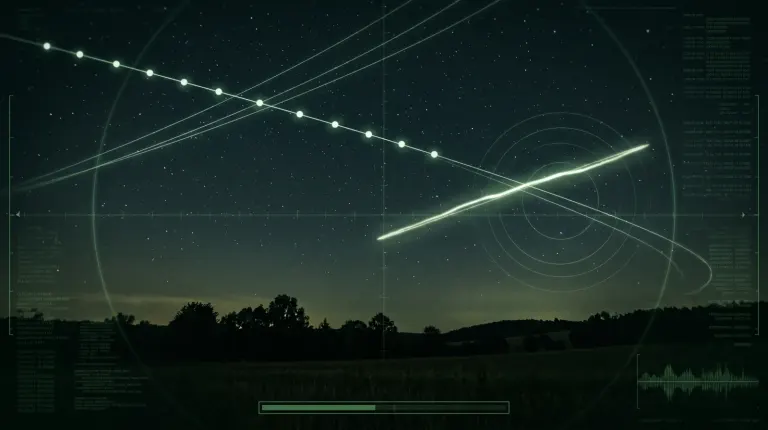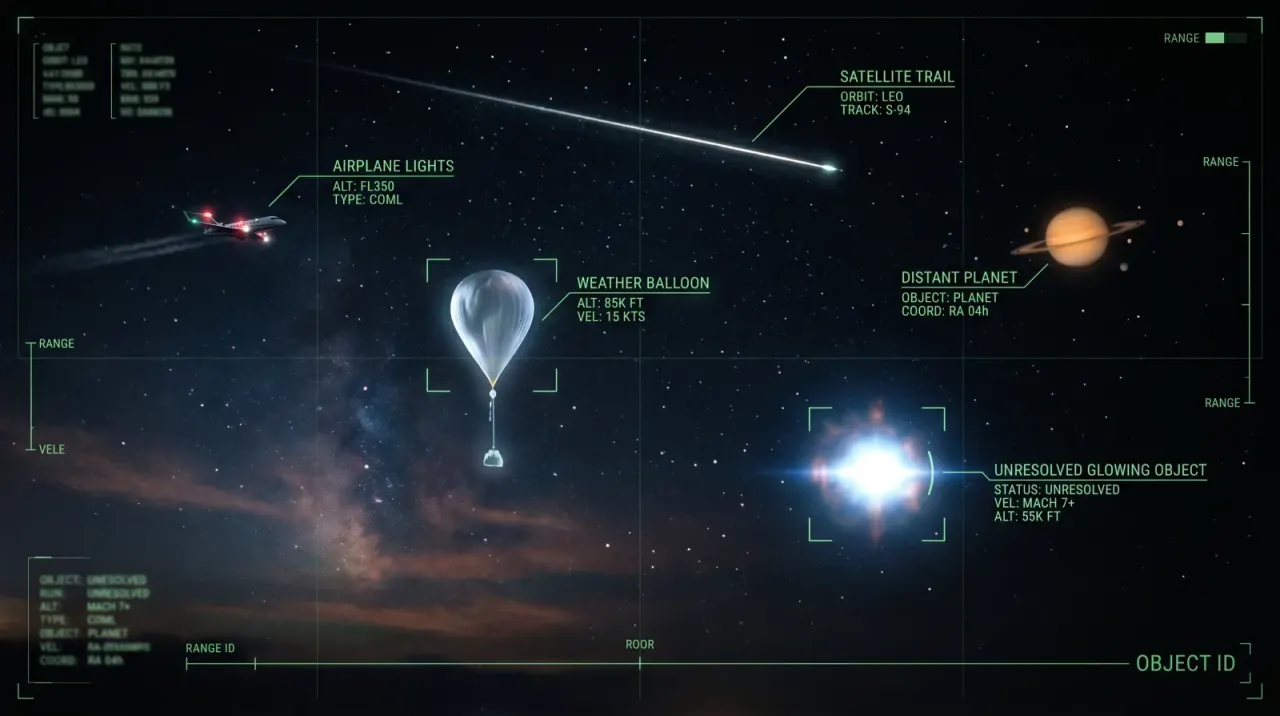
A flashing light in the sky is usually an aircraft, a bright star twinkling low on the horizon, a beacon on a tower or airport, or sunlight glinting off a satellite. If it moves at a steady pace with a regular strobe, it is an aircraft. If it stays with the stars and throws off red and green glints, it is a star. If it pulses red from one fixed spot above the skyline, it is a tower. A sudden bright flash from a slowly moving point is usually a satellite catching the Sun.
The fastest way to sort them is to count. Aircraft strobes, tower lights and airport beacons each flash at a rate set by regulation. A star follows no rhythm at all.
The ten-second flash count
Watch the light for ten seconds and count the flashes. Then check whether it moved against the stars or the skyline. The counts below are converted from the per-minute rates in the US rules cited further down.
| Does it move? | Flashes in 10 seconds | Colour | Most likely |
|---|---|---|---|
| Yes, at a steady pace. | Between 7 and 17, regular, with steady lights as well. | White strobe or red beacon, plus steady red, green and white. | An aircraft. |
| No. | About 5 slow pulses, often several lights pulsing together in a vertical line. | Red. | A tower or other tall structure. |
| No, low on the skyline. | 4 to 5, colours taking turns. | White and green. | An airport beacon. |
| Only with the stars. | No rhythm. A shimmer with quick glints. | White, flickering red and green. | A bright star low in the sky. |
| Yes, smoothly, like a star. | One flash, or a few irregular pulses. | White. | Sunlight off a satellite, or a tumbling rocket body. |
| Yes, inside one small patch low in the sky, late at night. | Several bright flashes that seem to spin or form shapes. | White. | Starlink flares. |
| Hovers, stops or reverses. | A steady, regular flash. | Any. | A drone. |
Aircraft: strobes on a moving light
Airliners carry an anti-collision system of aviation red or aviation white lights that must flash between 40 and 100 times a minute (14 CFR 25.1401), which works out to 7 to 17 flashes in ten seconds. Aircraft equipped with these lights must fly with them on, though the pilot may switch them off when that is safer (14 CFR 91.209). Alongside the flashes, steady position lights burn red on the left wing, green on the right and white at the tail (14 CFR 25.1385).
A moving light with a regular white or red flash and steady coloured lights is an aircraft. If the part you noticed was green, the green light file explains which side of the aircraft you were seeing.
Stars that flash red and green
A light that sits still and flashes colours is usually a star. Every star's light passes through Earth's atmosphere, and a star low in the sky shines through far more of it. EarthSky explains that the atmosphere refracts the light the way a prism splits sunlight, which produces red and green flashes. The colour comes from the air, not the star, and the glints fade as the star climbs higher.
In autumn from the Northern Hemisphere, EarthSky names three usual suspects: Capella, low in the northeast in the evening; Arcturus, in the northwest soon after nightfall; and Sirius, in the southeast to south after midnight. Planets shine more steadily, but they can twinkle too when they sit low.
Satellite glints and tumbling rocket bodies
AARO, the Pentagon's UAP office, explains that many satellites look like stars moving across the night sky, and that a satellite flares when sunlight reflects off a smooth surface such as an antenna or solar panel. That flash is far brighter than the satellite's normal glow and lasts only moments. For years the best-known flashes came from the first Iridium satellites, a set of 66 launched from 1997, which EarthSky reported in January 2019 had been phased out.
Spent rocket stages flash too. EarthSky notes that some rocket bodies stay in orbit for weeks, months or years after a launch, and as they tumble they can look like a dim moving star that throws off bright flashes. A light that moves at a satellite's steady pace, with no strobe and no sound, and brightens in pulses, fits this.
Starlink flares
AARO published an information paper on Starlink flares in December 2024. It says the satellites in their working position carry mirrored panels and flat antennas facing the Earth, and when the Sun, a satellite and an observer line up, the flare can be orders of magnitude brighter than starlight. Several satellites can flare at once in a small area of sky, which AARO says can look like spinning lights, glowing orbs that vanish and reappear, or shapes such as triangles.
The paper gives a timing rule for the current Starlink satellites. Flares are generally visible when the Sun is about 38 to 46 degrees below the horizon, which is well after dark, and they appear between the horizon and about 10 degrees above it. AARO staff photographed such flares near Sidney, Nebraska, on March 11, 2024. A separate 2024 study by Anthony Mallama and Richard E. Cole applied the same physics to an extreme flare that the pilots of two commercial aircraft had reported as a UAP. A line of evenly spaced lights is a different thing, a train of newly launched satellites, covered in Starlink vs UFO.
Towers and airport beacons: flashing in place
A red light pulsing from one fixed point above the skyline is usually an obstruction light on a tall structure. The FAA's obstruction lighting standard, Advisory Circular 70/7460-1N (August 2026), sets red flashing beacons at 30 flashes per minute, give or take 3, with the lights at different heights on a structure flashing together. That is about five slow pulses in ten seconds, often stacked in a vertical line.
An airport beacon also flashes in place but alternates colours. The FAA's Aeronautical Information Manual lists white and green for a lighted land airport, at 24 to 30 flashes a minute.
Drones
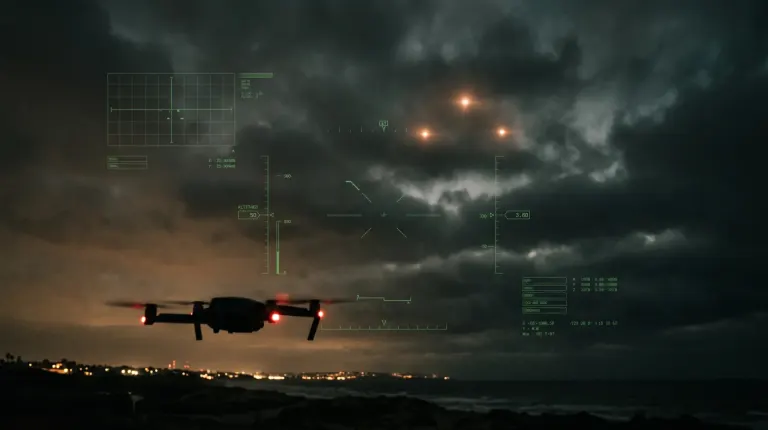
A drone flown at night under US rules must show lighted anti-collision lighting visible for at least 3 statute miles, with a flash rate sufficient to avoid a collision (14 CFR 107.29). The flash alone will not separate a drone from a small plane. The movement will: a drone hovers, stops, reverses and climbs straight up. Drone vs UFO covers the rest.
What to do next
Note the time, the direction you faced, how high the light was, your flash count and whether it moved. If it stayed with the stars, it was a star or planet. For anything that moved, enter the details in the sky identifier, which checks the real positions of satellites, Starlink and the planets for that minute. If none fits, the report builder turns your notes into a report you keep and shows where to send it.
For a light that will not hold still on camera, how to film a light at night has the settings. For the wider list of look-alikes, see airplane, satellite, balloon or UFO.
Sources
- eCFR, 14 CFR 25.1401, Anticollision light system
- eCFR, 14 CFR 91.209, Aircraft lights
- eCFR, 14 CFR 25.1385, Position light system installation
- eCFR, 14 CFR 107.29, Operation at night
- EarthSky, Flashing star in autumn? Here are 3 candidates, Deborah Byrd (updated September 2026)
- EarthSky, Why do stars twinkle, but planets don't? Deborah Byrd, June 28, 2026
- EarthSky, So long, Iridium flares, Deborah Byrd, January 7, 2019
- AARO, Correlations of Starlink Satellite Flaring with UAP Observations, December 2024
- Anthony Mallama and Richard E. Cole, Extreme Flaring of Starlink Satellites, arXiv, May 21, 2024
- FAA, Advisory Circular 70/7460-1N, Obstruction Marking and Lighting, August 11, 2026
- FAA, Aeronautical Information Manual, Chapter 2 Section 1, Airport lighting aids
- NASA, Spot the Station
Common questions
What is a flashing light in the sky that is not moving?
Usually a bright star low in the sky, twinkling through thick air, or a fixed beacon. Stars flash colours with no rhythm. Tower lights pulse red about 30 times a minute. Airport beacons alternate white and green.
What is the star that flashes red and green?
In autumn it is often Capella, Arcturus or Sirius, depending on the hour. The colours come from Earth's atmosphere refracting the starlight while the star is low, and they fade as it climbs.
Do satellites flash?
Sometimes. Sunlight reflecting off a satellite's panels or antennas can make a brief, bright flare, and tumbling rocket bodies can pulse. NASA notes the space station itself has no flashing lights.
Is a flashing light in the sky a UFO?
A regular flash is the signature of something built to be seen: an aircraft, a drone, a tower or a beacon. Check those, and the stars, before you call it unidentified.