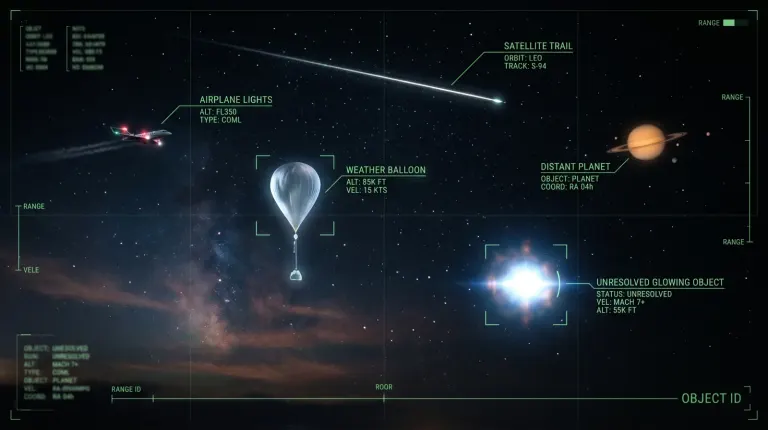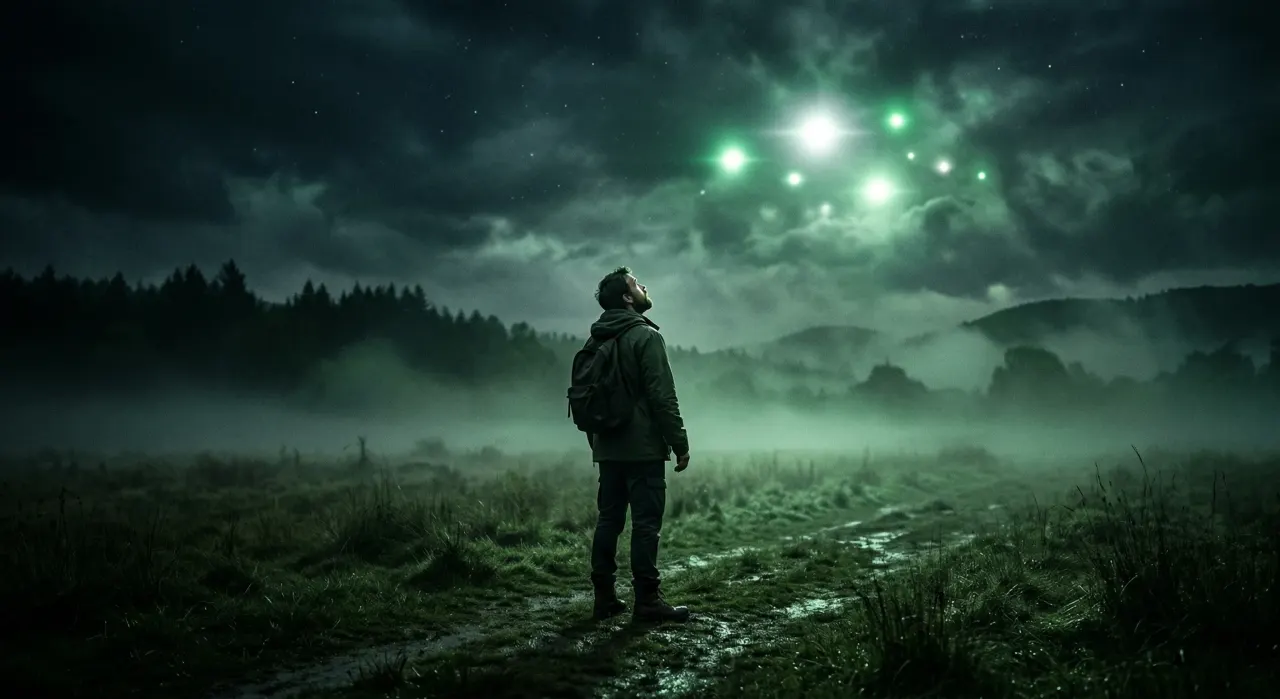
A green light in the sky usually has an ordinary source, and the way it moves tells you which one. A green streak that crosses the sky in a few seconds is most likely a fireball, a very bright meteor. A steady green point moving with other lights is an aircraft's right wingtip. A green flash that repeats from one fixed spot is often an airport beacon. A thin green line rising from the ground is a laser. A soft green glow in arcs or curtains is the aurora.
None of these needs a telescope to sort out. You need three details: how long it lasted, whether it moved, and whether it flashed. The table below does the rest.
The green light decision table
Find the row that matches what you saw. The last column is how to confirm it.
| What you saw | Most likely | How to confirm |
|---|---|---|
| A green streak or ball that crossed part of the sky in a few seconds, sometimes breaking up or flaring at the end. | A fireball, a very bright meteor. | It was over in seconds. Note where it started and ended, then report it. |
| A steady green point moving at a plane's pace, with a white light behind it and a flashing strobe or red beacon nearby. | An aircraft, seen from its right side. | Keep watching. If it turns, a steady red light shows on the other wing. |
| Green and white flashes taking turns from one spot low on the skyline, every two seconds or so, night after night. | An airport beacon. | Look for an airport in that direction on a map. |
| A thin, straight green beam rising from the ground, or a green dot sweeping across cloud. | A handheld laser. | Note the direction of the source and report it to police. |
| A pale green glow in arcs, curtains or rays that change shape over minutes. | The aurora. | Check the aurora forecast from NOAA's Space Weather Prediction Center. |
| A steady white point gliding smoothly across the sky, with no colour and no flashing. | A satellite or the space station. Not a green light at all. | Enter the time and direction in the sky identifier. |
Green fireballs: why a meteor turns green
The American Meteor Society (AMS) defines a fireball as a very bright meteor, generally brighter than magnitude −4, about as bright as Venus in the morning or evening sky. NASA's Center for Near Earth Object Studies uses a stricter test: magnitude −3 or brighter as seen straight overhead.
Colour comes from what burns. The AMS explains that elements in a meteoroid give off signature colours when they vaporise: sodium shows as bright yellow, nickel as green and magnesium as blue-white. Speed plays a part too. The AMS also asks for some caution with reported colours, because the eye holds on to a sudden bright light (persistence of vision) and can misjudge it.
The giveaway is time. The AMS asks people not to report anything that lasted more than 30 seconds, because the vast majority of fireballs are visible for only a few seconds. A green light that lingers for minutes is something else. If yours was a streak, the fireball field guide covers what to write down and where to send it.
Aircraft lights: green is the right wing
US rules for airliners put a red position light on the left side and a green one on the right, spaced as far apart as practicable, with a white light at the tail (14 CFR 25.1385). Pilots must fly with lighted position lights from sunset to sunrise (14 CFR 91.209).
So a lone green light means you are looking at the aircraft's right side. When both colours show and the red one is on your right, the aircraft is heading toward you. The position lights burn steadily. The flashing comes from separate anti-collision lights, which are aviation red or aviation white and flash between 40 and 100 times a minute (14 CFR 25.1401). A steady green light paired with a regular white or red flash is an aircraft. Drones carry lights too, and drone vs UFO covers how they behave.
Airport beacons: the green flash that stays put
A light that flashes green and white from the same place every night is usually an airport beacon. The FAA's Aeronautical Information Manual says a white-and-green beacon marks a lighted land airport, and that beacons marking airports flash 24 to 30 times a minute. Military airport beacons also alternate white and green, with two quick white flashes between each green one. Beacons are aimed to be most visible from one to ten degrees above the horizon, which is why they read as a low light on the skyline.
For other lights that blink in place, such as tower lights and twinkling stars, see what is that flashing light in the sky.
Green lasers: a beam from the ground
A laser looks different from everything above: the light starts near the ground and points up. The FAA reports that over 90% of aircraft illuminations by handheld lasers are green. Pilots reported 10,993 laser strikes to the FAA in 2025.
Pointing a laser at an aircraft is a federal crime in the United States, and the FAA can fine people up to $32,646 per violation. In Canada, Transport Canada says a person convicted of intentionally interfering with an aircraft by using a laser could face up to $100,000 in fines, up to 5 years in prison, or both. If you see someone aiming a laser at an aircraft, report it to local police. The FAA also asks for reports of laser strikes.
Aurora: when the whole sky goes green
The aurora is the one green light that can cover half the sky. NOAA's Space Weather Prediction Center says the most common auroral colour is pale green, produced by oxygen atoms high in the atmosphere. The aurora is best seen between about 60 and 75 degrees latitude, and it reaches further toward the equator during strong geomagnetic storms. In the evening it often shows as an arc spanning east to west, sometimes built from tall rays that look like a hanging curtain.
A glow that fills part of the sky and changes shape over minutes is aurora. A single point of green light is not.
Why a green light is not a satellite
Satellites are seen by reflected sunlight. AARO, the Pentagon's UAP office, notes that many of them look like stars moving across the night sky. NASA describes the space station the same way: like an airplane or a very bright star, except it has no flashing lights and does not change direction. A moving white point is worth checking against satellite passes, and a line of them is probably a Starlink train. A green light points back to one of the sources above.
What to do next
If the table gave you an answer, you are done. If it did not, write down the time, your location, the direction you faced, how high the light was, and how long it lasted, while the memory is fresh.
Then enter those details in the sky identifier, which checks the real positions of the space station, Starlink, the planets and the brightest stars for that minute. If nothing fits, the report builder turns your notes into a clean report and shows where to send it. For next time, how to film a light at night covers framing and exposure, and airplane, satellite, balloon or UFO covers the wider list of look-alikes.
Sources
- American Meteor Society, Fireball FAQs (archived copy, December 30, 2025; the live AMS site is partly offline)
- American Meteor Society, Report a Fireball
- NASA JPL Center for Near Earth Object Studies, Fireballs introduction
- eCFR, 14 CFR 25.1385, Position light system installation
- eCFR, 14 CFR 25.1401, Anticollision light system
- eCFR, 14 CFR 91.209, Aircraft lights
- FAA, Aeronautical Information Manual, Chapter 2 Section 1, Airport lighting aids
- FAA, Laser Safety (updated August 12, 2026)
- FAA, Laser Hazards in Navigable Airspace, pilot safety brochure (2018)
- Transport Canada, Use hand-held lasers legally and safely (modified July 29, 2020)
- NOAA Space Weather Prediction Center, Aurora tutorial
- NOAA Space Weather Prediction Center, Aurora
- AARO, Correlations of Starlink Satellite Flaring with UAP Observations, December 2024
- NASA, Spot the Station
Common questions
Why is there a green light in the sky tonight?
The usual sources are an aircraft's right wingtip light, an airport beacon flashing green and white, a green fireball, a laser beam or the aurora. A steady green point that moves is usually an aircraft. A streak that is over in seconds is usually a meteor.
What does a green fireball mean?
It is a very bright meteor. Meteors give off colours as their elements vaporise, and the American Meteor Society lists green for nickel. A fireball lasts seconds, and it is worth reporting to the AMS.
Is a green light in the sky a UFO?
It is unidentified until you have checked the ordinary sources: aircraft, airport beacons, meteors, lasers and the aurora. If none of them fits, record what you saw and file a report.
Can a satellite look green?
Satellites are seen by reflected sunlight and look like moving stars. NASA says the space station has no flashing lights. A green or blinking light points to another source.