Orange lights in the sky are usually sky lanterns, flares, or a planet or bright star low on the horizon. Drones and slow meteors account for some of the rest. Lanterns drift with the wind and flicker. Flares hang, then sink slowly. A planet holds its place among the stars. One minute of watching which way the light goes is enough to separate them.
The checklist below sorts every orange light by one question: what does it do while you watch?
The orange light checklist: drift, sink or hold
Match the movement first. Colour and brightness come second.
| What the light does | Most likely | Next check |
|---|---|---|
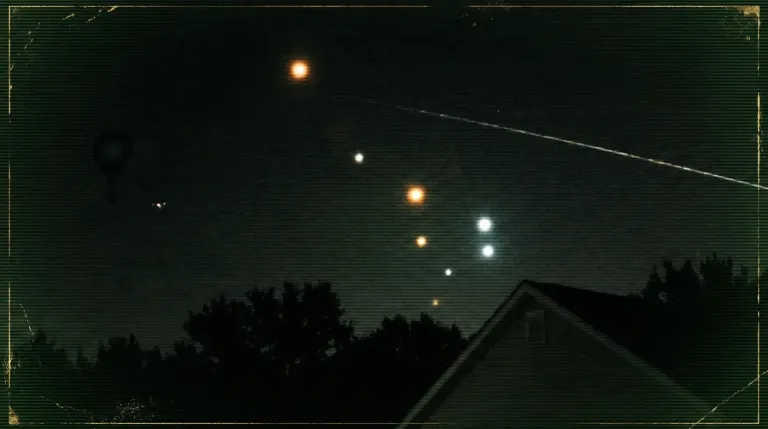
| Drifts with the wind, flickers, rises slowly, often in a loose string, then fades or goes out one by one. | Sky lanterns. | Check the wind. Lanterns go where it goes. |
| Hangs in place, then sinks slowly and straight down, sometimes in a row, and winks out one at a time. | Parachute flares. | Near a military range or the coast? See flares below. |
| Holds still against trees and rooftops, low on the horizon, and keeps its place among the nearby stars. | A planet or bright star, reddened by the air. | Check that direction in the sky identifier. |
| Moves against the wind, stops, hovers or reverses, with a blinking light. | A drone. | Listen for a buzz. Watch for a regular flash. |
| Crosses a large part of the sky in a few seconds, sometimes with a tail. | A slow meteor or fireball. | Under 30 seconds? Report it as a fireball. |
| Crawls nearly level across the sky for a minute or more, breaking into a line of glowing pieces. | Space debris or a rocket stage coming back down. | Record it. The fireball file explains the difference. |
Sky lanterns
A sky lantern is a small hot-air balloon of paper and wire, lifted by an open flame. MTU Blackrock Castle, an observatory in Ireland, describes the sighting as an "orange flickering light, floating around 50 to 100 metres above the ground." It notes that lanterns have become very common at celebrations, Halloween and New Year's Eve, so the date is a clue. A drifting string of orange lights on a holiday night is a strong lantern candidate.
They are also a fire hazard. The National Fire Protection Association says sky lanterns pose a serious fire safety hazard and that their use is prohibited by NFPA code requirements. Some local fire authorities ban them outright: Central Fire District in Santa Cruz County, California, prohibits them because they can travel through the air and come down in areas that can catch fire. Rules differ by place, so check with your own fire department before anyone lights one. The American Meteor Society asks people not to report sky lanterns as fireballs.
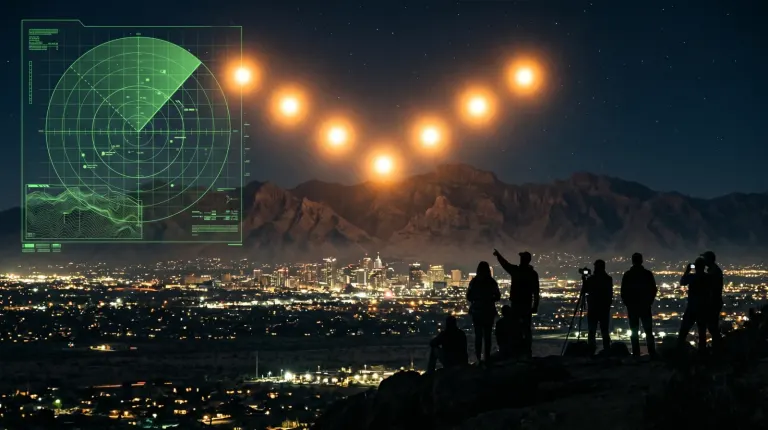
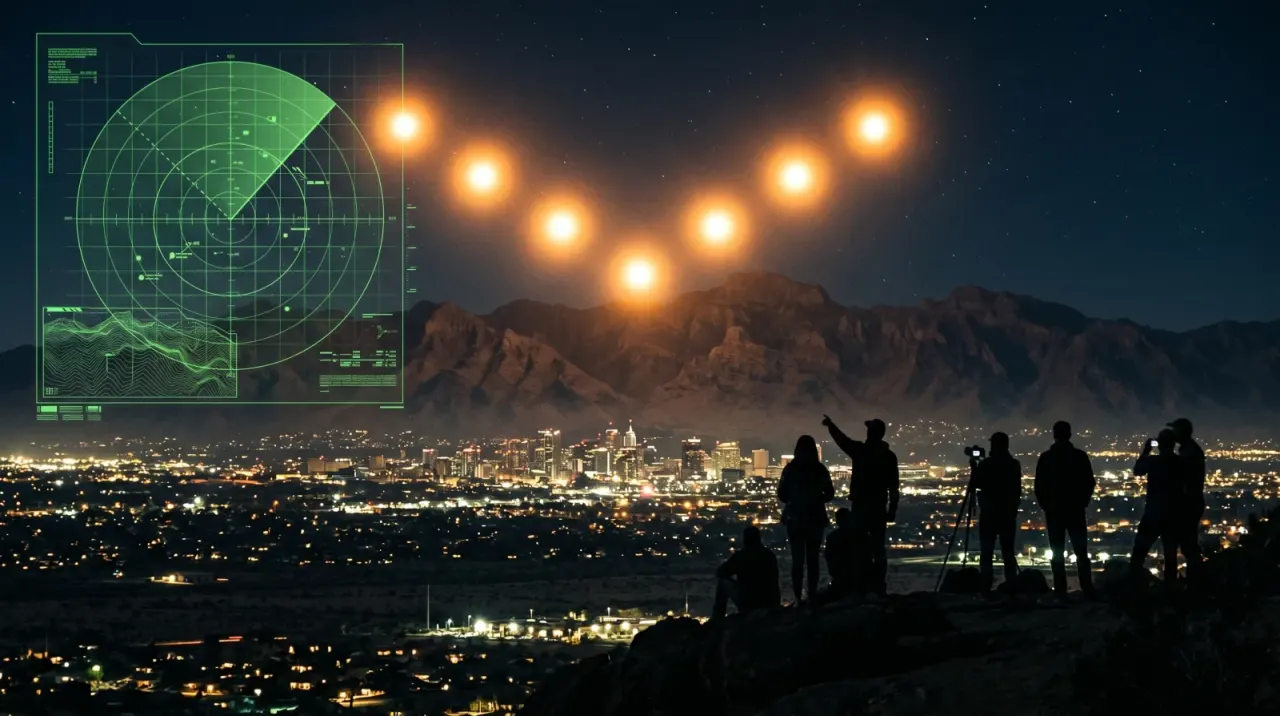
Flares: the Phoenix Lights pattern
Illumination flares are built to hang in the sky. In July 1997, the Maryland Air National Guard said eight of its A-10 jets had been training over the Barry M. Goldwater Air Force Range, about 60 miles southwest of Phoenix, on March 13, 1997, and had dropped flares there. A spokesman said the flares fall slowly by parachute and light a wide area, and that the planes dumped their remaining flares at high altitude before returning to base (Deseret News, July 26, 1997).
That account became the official explanation for the later lights seen over Phoenix that night. Many witnesses say an earlier, silent V-shaped formation was a separate event that flares do not explain, and that part is still argued. The full file is the Phoenix Lights explained.
Near the coast, MTU Blackrock Castle notes that a very bright red or green light about 200 metres up that appears to move very slowly can be a distress flare fired to alert nearby shipping. Treat that one as a possible emergency and call emergency services.
Planets and stars near the horizon
A bright point that does not drift, flicker out or sink is usually a planet or star. Mars is orange-red on its own: NASA says iron minerals in the Martian soil oxidise, or rust, and make the surface look red. Other bright lights pick up orange from the air. NASA explains that light from low in the sky passes through more atmosphere, which scatters the blue away and lets reds and yellows through, the reason sunsets turn red. EarthSky adds that anything near the horizon is seen through more air, which is also why low planets can twinkle.
Brightness helps. On the AMS scale, bright Venus reaches magnitude −4.5, bright Mars −2.8 and bright Jupiter −2.5, all brighter than Sirius at −1.6. The sky identifier shows which planets sat in the direction you looked at that minute.
Drones with lights
In the United States, a small drone flown at night must show lighted anti-collision lighting visible for at least 3 statute miles, with a flash rate sufficient to avoid a collision (14 CFR 107.29). A drone gives itself away by moving in ways a lantern, a flare or a planet cannot: hovering, stopping, reversing, climbing straight up. Drone vs UFO covers sound, hover and battery limits.
Orange streaks: slow meteors and re-entries
An orange light that crosses the sky in seconds is probably a meteor. The American Meteor Society notes that among fainter meteors, slow ones tend to be reported as red or orange and fast ones as blue. A light that crawls nearly level across the sky for a minute or more and breaks into a line of glowing pieces is more likely space debris. Michael J. I. Brown of Monash University explains that space junk enters the atmosphere at roughly 8 km per second, against tens of kilometres per second for meteors, and can take minutes to enter the atmosphere, travelling hundreds of kilometres as it does. The fireball file sets the two side by side.
What to do next
Write down four things while they are fresh: the time, where you stood, the direction you faced, and what the light did (drifted, sank, held still or darted). Those four answers map straight onto the checklist above.
Enter them in the sky identifier to rule out planets and satellites for that minute. If nothing fits, build a sighting report you can keep and send. For a light that blinked or pulsed, try what is that flashing light in the sky. For a steady ball of light with no clear source, what are orbs in the sky is the next file.
Sources
- MTU Blackrock Castle, How to identify a UFO
- National Fire Protection Association, Sky Lanterns Safety Tip Sheet
- Central Fire District (Santa Cruz County, California), Sky Lanterns Prohibited
- American Meteor Society, Report a Fireball
- Deseret News, Flares, not UFOs, caused light show, military says, July 26, 1997
- NASA Science, Mars facts
- NASA Space Place, Why is the sky blue?
- EarthSky, Why do stars twinkle, but planets don't? Deborah Byrd, June 28, 2026
- American Meteor Society, Fireball FAQs (archived copy, December 30, 2025; the live AMS site is partly offline)
- eCFR, 14 CFR 107.29, Operation at night
- The Conversation, Comet, rocket, space junk or meteor? Here's how to tell your fireballs apart, Michael J. I. Brown, May 11, 2025
Common questions
What are the orange lights in the sky tonight?
Most often sky lanterns, flares, or a planet or bright star low on the horizon. Lanterns drift and flicker, flares sink slowly, and planets hold their place among the stars. A drone moves against the wind and can hover.
Were the Phoenix Lights flares?
In July 1997 the Maryland Air National Guard said its A-10 jets had dropped flares over a range southwest of Phoenix on March 13, 1997, and flares became the official explanation for the later lights. Many witnesses say an earlier V-shaped formation was a separate event.
Are sky lanterns legal?
It depends where you are. The NFPA says their use is prohibited by NFPA code requirements, and some local fire authorities ban them because they can come down burning. Check with your local fire department.
Why does a planet look orange near the horizon?
Mars is orange-red because its surface is rusty. Any planet or star low in the sky also looks warmer, because its light passes through more air, which scatters the blue away.